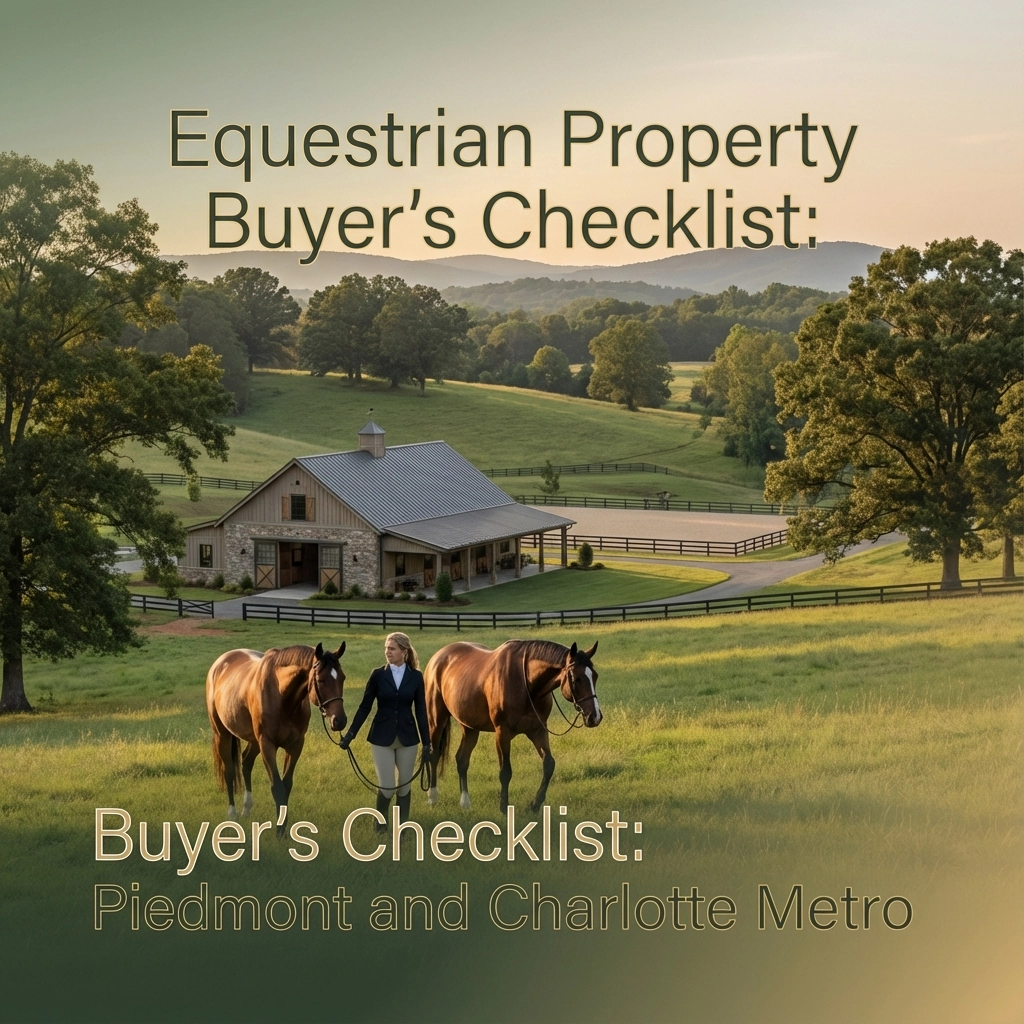
Work through this checklist in four passes: desk research before you tour, what to look at on the property, what to verify once you are under contract, and what to collect before closing. The Piedmont adds items a generic checklist misses: clay soils, some of which drain slowly and limit septic systems, wells drilled into fractured rock whose output can fall off after a strong start, and stream and flood rules that shrink usable ground.
Print it, take it to every property, and check items off as you go. For the barn, arena, and fence details, pair it with our horse property inspection checklist.
Phase 1: Before you tour
Most of these take an evening at a computer and a few phone calls. They can save you a wasted showing.
Parcel and paperwork
- Pull the county parcel record. Confirm the acreage, owner name, and deed reference match the listing.
- Confirm who regulates the parcel. Town limits, a town's ETJ, or county zoning each bring different rules. Our list of common buying mistakes explains why this matters.
- Read what is recorded. At the county Register of Deeds, look for the plat, easements, and any covenants or HOA declaration.
- Check the tax card for present-use value. If the land is enrolled, you will have a deadline after closing (see Phase 3).
Flood and stream rules
- Check flood hazard by address at flood.nc.gov, North Carolina's flood information center. Mapped floodplain is poor ground for barns, arenas, and manure storage.
- Find out if a state buffer rule applies. In the Goose Creek watershed, which covers parts of Union and Mecklenburg counties around Mint Hill, Indian Trail, Stallings, Fairview, and Hemby Bridge, state rules require undisturbed riparian buffers within 200 feet of water bodies inside the 100-year floodplain and within 100 feet outside it. The state rule treats existing uses such as pasture as exempt for their footprint, but don't plan to clear new paddocks inside a buffer.
Soils: drainage and septic
Look up the parcel on the USDA's Web Soil Survey. Its Soil Data Explorer tab lets you check how suitable the soils are for a particular use, so look at drainage and at any ratings tied to septic systems. Two Piedmont soil series show why the name on the map matters.
The Cecil series, common across Piedmont uplands, is rated well drained with low shrink-swell potential. The Iredell series, which NRCS lists as established in the Statesville area of Iredell County in 1901, behaves very differently:
"The Iredell series consists of moderately well drained, very slowly permeable soils."
Very slow permeability means water moves down through the soil slowly. That can leave paddocks wet longer and make septic drain fields harder to site. If the map shows soils like this where the paddocks, arena, or drain field sit, plan to look closely on the tour. Our guide to judging pasture before you buy covers what the soil map tells you about grass.
Phase 2: On the tour
Water on the ground
- Note where the barn roof drains and where that water goes next.
- Look for red clay splashed on the lower fence boards and barn walls, a sign of mud and standing water.
- Walk the low corner of each paddock and the ground at every gate.
- Look for gullies along fence lines and below the arena.
Well and septic locations
- Find the wellhead. Note how far it sits from the manure pile, paddocks, and any fuel storage.
- Find the septic tank and drain field. Make sure the driveway, trailer parking, and turnout don't cross them. Heavy trucks and hooves don't belong on a drain field.
- Ask for the paperwork now: the well construction record, the septic permit, any recent pump-out receipts, and past water test results.
Use and access
- Count stalls, measure the hay storage, and check where a delivery truck would unload.
- Drive or walk the trailer route from the road to the barn and back out.
- Ask which paddocks get closed in winter and why.
Phase 3: Under contract
This is your due diligence period. The NC Real Estate Commission explains that during it, a buyer can terminate for any reason or no reason by written notice, and typically gets back the earnest money but not the due diligence fee. Schedule the slow items first.
Well: test sustained yield, not a first impression
Many Piedmont wells draw water from fractures in crystalline rock, and the U.S. Geological Survey explains why a strong start can mislead:
"Wells that penetrate only a few small, shallow fractures initially may have an adequate yield; however, after the fractures are drained, well yield can suddenly decrease and the sustained yield may be small."
USGS, Ground Water Atlas of the United States: Piedmont and Blue Ridge Aquifers
Ask a well contractor for a flow test long enough to show sustained yield and recovery, not a quick reading. Compare the result with your barn's peak demand on a hot day. Our guide to water on NC horse properties covers daily water use and the lab tests to order.
Septic: inspect it, and know the rules for adding on
- Have the system inspected and pumped if the records are thin.
- Pull the county environmental health office's permit file to confirm what the system was approved for and where it sits.
- If you plan a barn bathroom, an apartment, or a new house, the soils have to support a new or expanded system. Under G.S. 130A-335, a licensed soil scientist may evaluate a proposed site's soils and site features. Under G.S. 130A-338, other construction permits for a residence or place of business generally can't be issued until the wastewater system's construction authorization, or another approval the statute allows, is in place. On slowly permeable soils, get that answer before you count on the plan.
Survey, title, and appraisal
- Order a survey that shows fence lines against the true boundary. Old farm fences don't always follow the boundary.
- Have your attorney review easements, access, and any recorded restrictions.
- Make sure the lender's appraiser knows the property has a barn and acreage so comparable sales are chosen with that in mind.
Present-use value: mark the 60-day deadline
If the farm is enrolled in present-use value and you plan to keep it there, state law sets a deadline after the sale:
"An application required due to transfer of the land may be submitted at any time during the calendar year but must be submitted within 60 days of the date of the property's transfer."
Ask the county assessor during due diligence if your planned use will qualify, and put the deadline on your calendar before closing.
Phase 4: Before closing
The NC Real Estate Commission notes the buyer has the right to verify agreed repairs and to do a final walk-through. On a horse property, use it to:
- Confirm repairs were made, and get receipts
- Test hydrants, automatic waterers, and fence chargers
- Collect gate codes, keys, and manuals for pumps and chargers
- Get well, septic, and pest service records, and the names of the vendors the seller used
One-page summary
| Phase | Item | Who has the answer |
|---|---|---|
| Before touring | Jurisdiction and zoning district | Town or county planning office |
| Before touring | Plat, easements, covenants | Register of Deeds |
| Before touring | Flood hazard | flood.nc.gov |
| Before touring | Soil drainage and septic ratings | USDA Web Soil Survey |
| On the tour | Drainage, well and septic locations | Your own walk, the seller |
| Under contract | Sustained well yield | Well contractor |
| Under contract | Septic condition and permit file | Septic inspector, county environmental health office |
| Under contract | Boundaries and fence lines | Surveyor, real estate attorney |
| Under contract | Present-use value status | County assessor |
| Before closing | Repairs and final walk-through | You and your agent |
For the full buying process from first search to closing, see our guide to buying a horse farm in North Carolina. If you want help scheduling inspections on a specific property, contact us.
Sources
- NC Emergency Management, flood.nc: North Carolina's Flood Information Center
- NC DEQ, Goose Creek Watershed Water Quality Management Plan: A Guide for Homeowners and Citizens
- USDA NRCS, Web Soil Survey
- USDA NRCS, Official Series Description: Cecil Series
- USDA NRCS, Official Series Description: Iredell Series
- NC Real Estate Commission, Due Diligence Questions and Answers
- USGS, Ground Water Atlas of the United States: Piedmont and Blue Ridge Aquifers
- NC General Assembly, G.S. 130A-335: Wastewater collection, treatment and dispersal
- NC General Assembly, G.S. 130A-338: Construction authorization required before other permits to be issued
- NC General Assembly, G.S. 105-277.4: Agricultural, horticultural and forestland, application and deferred taxes