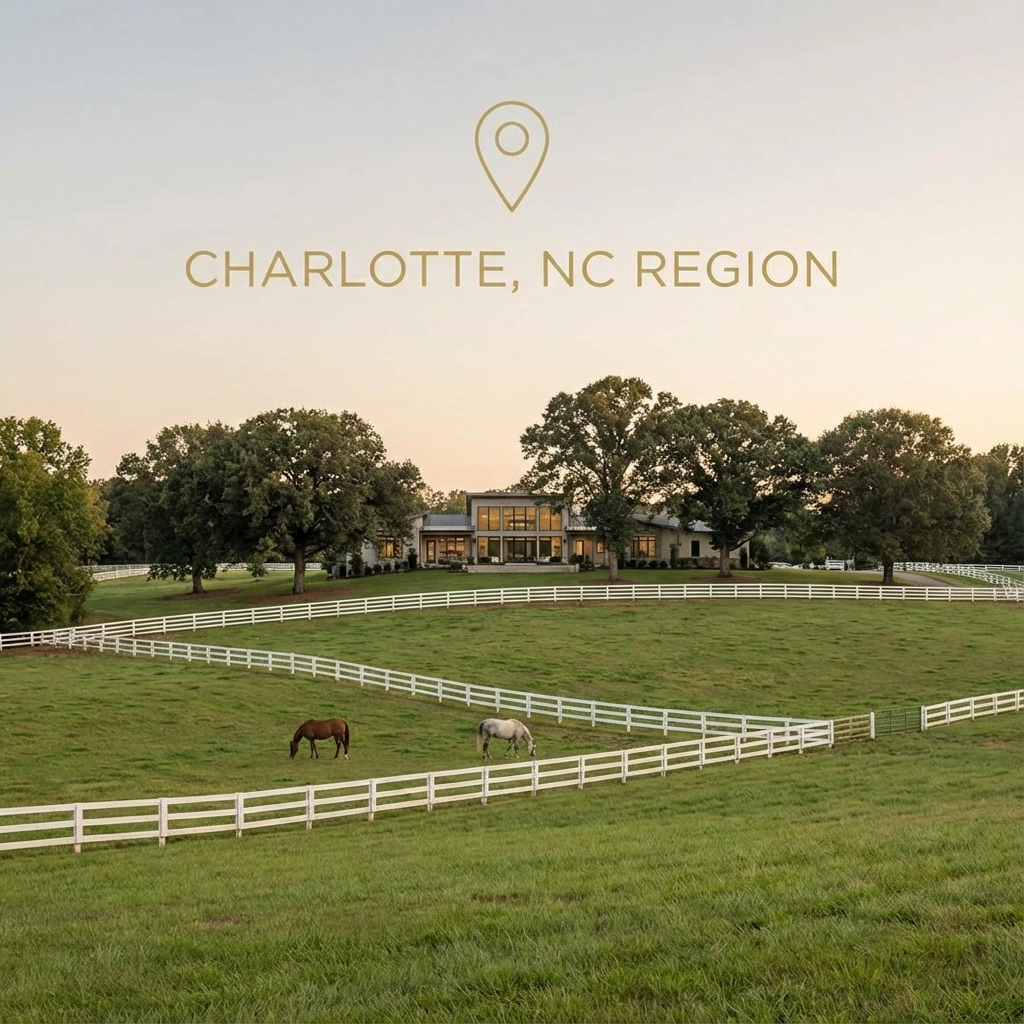
Near Charlotte, keeping horses at home is most realistic outside town limits in the counties that ring Mecklenburg: Union to the southeast, Iredell to the north, Cabarrus and Rowan to the northeast, Gaston and Lincoln to the west, and York and Lancaster across the South Carolina line. Those counties still have most of the region's farmland and horses, and North Carolina limits how county zoning can regulate farms. Inside town limits, horses depend on each town's zoning and on private covenants, lot by lot.
This guide is organized by direction from Charlotte. It uses county-level data and rules rather than naming subdivisions, because whether a specific neighborhood allows horses is decided by its recorded covenants, not by its name.
The line that matters most: town limits
North Carolina treats farms differently depending on who controls zoning. The UNC School of Government summarizes the rule:
"Land use zoning does not apply to bona fide farm activities in county jurisdiction and in municipal extraterritorial jurisdiction (ETJ)."
UNC School of Government, Bona Fide Farms and Development Regulations
G.S. 160D-903 is the statute behind it, and North Carolina's definition of agriculture in G.S. 106-581.1 includes the care and training of horses. Inside a town's limits, the exemption does not apply, so the town's ordinance decides whether horses are allowed, how many, and on how much land.
Three practical points follow:
- Check the jurisdiction line first. Two farms on the same road can sit under different rules if one is inside town limits.
- Know what counts as a farm. G.S. 160D-903(a1) lists evidence the county will accept, such as a farm sales tax exemption certificate, present-use value (PUV) eligibility, or a Schedule F. A family with two pleasure horses may or may not meet that standard, so ask the county planning office how it would treat your plans.
- Read the covenants too. The exemption limits government zoning. Recorded subdivision restrictions are private, so read them for every lot you consider.
For a deeper look at zoning questions, see our guide to Charlotte-area horse property zoning.
Where the horses and farmland are
The USDA's 2022 Census of Agriculture counts horses and ponies on farms in each county. Keep its definition in mind:
"a farm is defined as any place, urban or rural, that produced and sold, or normally would have sold, $1,000 or more of agricultural products during the census year."
USDA National Agricultural Statistics Service, Census of Agriculture FAQs
So these numbers miss many backyard horses. They still show where farm activity is concentrated:
| County | Direction from Charlotte | Horses and ponies (Dec. 31, 2022) | Land in farms (acres) |
|---|---|---|---|
| Mecklenburg, NC | Center | 274 | 7,704 |
| Iredell, NC | North | 710 | 119,481 |
| Rowan, NC | Northeast | 1,195 | 104,888 |
| Cabarrus, NC | Northeast | 763 | 64,227 |
| Stanly, NC | East | 394 | 109,164 |
| Union, NC | Southeast | 1,116 | 212,066 |
| York, SC | South | 1,708 | 105,092 |
| Lancaster, SC | South | 926 | 60,781 |
| Chester, SC | South | 615 | 114,795 |
| Gaston, NC | West | 692 | 36,859 |
| Lincoln, NC | Northwest | 779 | 49,038 |
Mecklenburg's 7,704 acres of farmland is a small fraction of what each neighboring county has, so a search for horse acreage near Charlotte usually leads across the county line. Our horse farms near Charlotte page and our county guides cover current options in each area.
North: Iredell County
Iredell had 710 horses and ponies, 119,481 acres in farms, and 25,664 acres of pastureland in the 2022 Census. Mooresville is in Iredell County, and the town has its own zoning, so the farm exemption matters most on land outside town limits.
Iredell County has an Enhanced Farmland Preservation Ordinance, adopted in 2007 and amended through November 2021. Under it, an enhanced agricultural district starts with at least 25 contiguous acres of qualifying farmland or land within a mile of an existing district.
Northeast and east: Cabarrus, Rowan, and Stanly
These three counties hold a lot of farmland. Rowan had the most horses of the North Carolina counties in the table, 1,195, on 104,888 acres in farms. Stanly had 109,164 acres in farms but fewer horses, 394. Cabarrus had 763 horses on 64,227 acres.
Cabarrus and Rowan both run voluntary agricultural district programs. Cabarrus requires at least 20 contiguous acres of qualified farmland to form a district. Rowan certifies qualifying farmland starting at 5 acres.
Southeast: Union County
Union had the most land in farms in the table, 212,066 acres, plus 20,600 acres of pastureland and 1,116 horses and ponies. Weddington, Marvin, and Waxhaw are Union County towns, and each has its own zoning. Outside those towns, county zoning and the farm exemption apply.
Union County's Voluntary Farmland Preservation Program requires a district to contain at least 20 contiguous acres of qualified farmland, or two or more qualified farms of at least 20 acres within a mile of each other.
South: York, Lancaster, and Chester counties, SC
York County had 1,708 horses and ponies in 2022, the highest count in this group, on 105,092 acres in farms. Lancaster had 926 and Chester had 615. North Carolina's farm zoning statute does not apply in South Carolina, so each county's own zoning ordinance controls. Start with our York County, SC horse property guide.
West and northwest: Gaston and Lincoln
Lincoln had 779 horses and 49,038 acres in farms. Gaston had 692 horses and 36,859 acres. Gaston's voluntary agricultural district ordinance requires at least 20 contiguous acres for a district, and Lincoln has an Enhanced Agricultural District Ordinance.
Lincoln County's planning staff also proposed in August 2025 to remove the county's riding stable standards from its development ordinance, because riding stables are treated as part of a bona fide farm under state law. Ask the county whether that change was adopted if you plan to board horses.
How to check a specific road or parcel
County numbers point you to an area. These steps tell you about one property:
- Find the jurisdiction. Use the county GIS map to see whether the parcel is inside town limits, in a town's ETJ, or under county zoning.
- Look for nearby agricultural districts. Look for the voluntary agricultural district notice in the land records (see below), or ask the county's agricultural advisory board, which every district ordinance creates, where enrolled farms are.
- Check the zoning district and its rules. Ask the planning office which district applies and whether it limits livestock, barns, or setbacks.
- Pull the recorded covenants. The Register of Deeds has subdivision restrictions. Look for limits on the number of horses, barn size, fencing type, and outbuildings.
- Look at the neighbors' land use. Check the tax records for nearby parcels to see whether they are enrolled in present-use value, a sign the area is still farmed.
Step 2 is easier than it sounds, because North Carolina requires counties to flag land near enrolled farms:
"All counties shall require that land records include some form of notice reasonably calculated to alert a person researching the title of a particular tract that such tract is located within one-half mile of the property line of any tract of land enrolled in a voluntary agricultural district."
A nearby district is a good sign for a horse buyer. G.S. 106-738 says these districts exist partly to decrease the likelihood of nuisance disputes between farm owners and their neighbors.
A word on equestrian communities
A neighborhood with farm or equestrian in its name does not necessarily let you keep a horse on your lot. Some communities allow horses only at a shared barn, some limit the number per acre, and some do not allow them at all. Ask for the recorded declaration and any architectural guidelines before you make an offer. Our equestrian communities guide covers the planned communities in the Carolinas.
If you want help narrowing a search to areas where your horses can live at home, contact us.
Sources
- UNC School of Government, Bona Fide Farms and Development Regulations
- North Carolina General Statutes, G.S. 160D-903 Agricultural uses
- North Carolina General Statutes, G.S. 106-581.1 Agriculture defined
- USDA National Agricultural Statistics Service, Census of Agriculture FAQs
- USDA NASS, 2022 Census of Agriculture County Profile, Mecklenburg County, NC
- USDA NASS, 2022 Census of Agriculture County Profile, Iredell County, NC
- USDA NASS, 2022 Census of Agriculture County Profile, Rowan County, NC
- USDA NASS, 2022 Census of Agriculture County Profile, Cabarrus County, NC
- USDA NASS, 2022 Census of Agriculture County Profile, Stanly County, NC
- USDA NASS, 2022 Census of Agriculture County Profile, Union County, NC
- USDA NASS, 2022 Census of Agriculture County Profile, York County, SC
- USDA NASS, 2022 Census of Agriculture County Profile, Lancaster County, SC
- USDA NASS, 2022 Census of Agriculture County Profile, Chester County, SC
- USDA NASS, 2022 Census of Agriculture County Profile, Gaston County, NC
- USDA NASS, 2022 Census of Agriculture County Profile, Lincoln County, NC
- NCDA&CS Farmland Preservation, Iredell County Enhanced Farmland Preservation Ordinance
- NCDA&CS Farmland Preservation, Cabarrus County Voluntary Agricultural District Ordinance
- NCDA&CS Farmland Preservation, Rowan County Farmland Preservation Ordinance
- NCDA&CS Farmland Preservation, Union County Voluntary Farmland Preservation Program Ordinance
- NCDA&CS Farmland Preservation, Gaston County Voluntary Agricultural Districts Ordinance
- NCDA&CS Farmland Preservation, Lincoln County Enhanced Agricultural District Ordinance
- Lincoln County Planning and Inspections, UDO Proposed Amendment #2025-4
- North Carolina General Statutes, G.S. 106-741 Record notice of proximity to farmlands
- North Carolina General Statutes, G.S. 106-738 Voluntary agricultural districts
- North Carolina General Statutes, G.S. 106-739 Agricultural advisory board