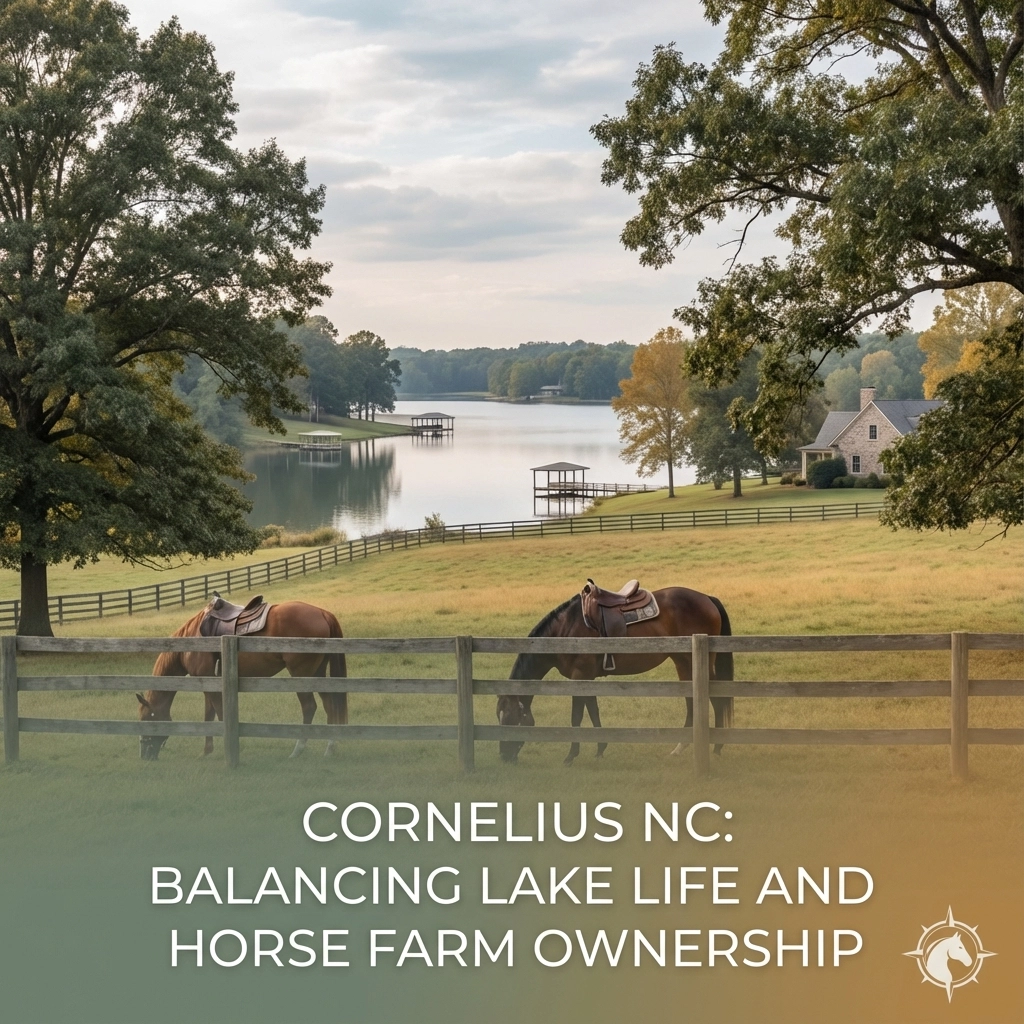
Yes, but rarely inside Cornelius itself. The town's Land Development Code allows agricultural uses by right only in its Rural Preservation (RP) district, which requires a 3-acre minimum lot, while the town's main residential districts allow lots of half an acre or smaller. Realistic horse land near the lake sits on the edges: Davidson's rural area, Mooresville's Rural Conservation district, unincorporated Iredell County, and the west shore in Lincoln County.
Why Cornelius has so little horse land
Cornelius is compact. Its Quick Facts page lists the town's area as 15.20 square miles, and Lake Norman sets the pattern for the area:
"The namesake lake is the largest manmade lake within the state, and the park covers about 17 miles of its northern shoreline."
The code describes the General Residential (GR) district this way:
"Such development has traditionally been found along the lakefront and in conventional subdivisions."
Town of Cornelius Land Development Code, Chapter 4: Zoning Districts
GR has a half-acre minimum lot, and Neighborhood Residential (NR) has a one-third-acre minimum. Neither district lists agricultural uses in the town's use table.
The one district built for agriculture: Rural Preservation
The Cornelius code was adopted on March 19, 2018, and the town's page says it was last amended on February 16, 2026. Its use table marks Agricultural Uses as permitted by right in one column only: RP.
"The Rural Preservation District is coded to accommodate very low-density residential development, agricultural uses, and protect natural vistas and landscape features that define our rural heritage."
Town of Cornelius Land Development Code, Chapter 4: Zoning Districts
Key RP numbers from the code's dimensional table:
| Standard | RP requirement |
|---|---|
| Minimum lot size | 3 acres (130,680 sq. ft.) |
| Front / side / rear setback | 50 / 15 / 50 feet |
| Accessory building side and rear setback | 10 feet |
| Accessory height limit | 26 feet, with an exception noted for farm structures |
Barns count as accessory buildings
RP adds its own rules for accessory buildings, pools, and similar structures:
- Their combined footprint cannot exceed 7 percent of the lot area.
- On a minimum-size RP lot, no more than three accessory buildings are allowed. Larger lots may get more with Zoning Administrator approval.
- Accessory buildings go in the rear yard only (with a narrow exception for small detached garages).
- Any accessory building over 600 square feet must be at least 100 feet from the house.
Worked example: a 3-acre RP lot is 130,680 square feet, so 7 percent allows about 9,148 square feet of combined accessory footprint. That is room for a modest barn and a run-in shed. The tighter limits are usually the three-building cap and the 100-foot separation from the house, which together decide where a barn can sit.
The Lake Norman overlay
Cornelius also maps a Lake Norman Overlay (LN-O), a watershed district layered on top of the base zoning, so check if your parcel is inside it. In the overlay, single-family development is limited to two homes per acre, and under the low impervious option no residential lot can be smaller than half an acre. For everything else:
"All other residential and non-residential development shall be allowed at a maximum of 24% built-upon area or in accordance with Chapter 9.2 of this Code."
Town of Cornelius Land Development Code, Chapter 4: Zoning Districts
A high impervious option allows up to 50 percent built-upon area with engineered stormwater controls, but it cannot be used in the GR district. The overlay lists agriculture as an allowed use, subject to federal farm law and the rules of the state Soil and Water Conservation Commission. Separately, the dimensional table requires every structure in every district to sit at least 50 feet from Lake Norman's 760-foot contour. If you picture a barn near the shoreline, start with that line on the survey. Ask planning staff how a barn, a riding arena, and gravel parking would count toward built-upon area on your parcel.
HOA covenants can say no even when zoning says yes
Zoning is only half the answer. Subdivisions can have recorded covenants that limit animals, outbuildings, and fence types. A private covenant can prohibit horses on a lot where the town would allow them.
Before you make an offer on any Cornelius-area property with horses in mind:
- Get the full declaration of covenants and every recorded amendment, not a summary.
- Read the sections on animals, livestock, accessory buildings, fencing, and commercial use.
- Ask the HOA manager whether any rule changes are pending.
- If a current owner keeps horses, ask whether that use was approved in writing.
Your closing attorney can pull the recorded documents. Treat this step as seriously as the zoning check.
Where horse land near the lake realistically is
If Cornelius does not have the right parcel, these nearby jurisdictions have rules written with farms in mind:
| Area | What the code says | More detail |
|---|---|---|
| Davidson rural area | Horse Farm permitted in the Rural Planning Area; boarding capped at two horses per acre | Davidson horse farm guide |
| Mooresville, RC district | Farm permitted by right; Equestrian Center permitted | Mooresville zoning guide |
| Unincorporated Iredell County | Bona fide farms exempt from most of the county code; commercial stables fall under a use that needs a special use permit | Iredell County Land Development Code |
| Lincoln County (west shore) | Agriculture, defined as bona fide farm purposes, listed as permitted across the county's district table | Lincoln County UDO |
Mooresville's code describes its Rural Conservation district as a place where agricultural and other typical rural uses are generally appropriate. For the town itself, see our Mooresville area page.
Cornelius's extraterritorial area and farm status
A 1977 state law authorized Cornelius, along with Davidson and Huntersville, to apply its zoning up to one mile beyond its corporate limits. That matters because North Carolina's bona fide farm exemption, in G.S. 160D-903, reaches into a town's extraterritorial area but not inside its corporate limits. A working farm just outside town may be exempt from town zoning, while the same use one parcel inside the limits is not. Confirm which side of the line you are on before you rely on farm status.
Lake life or land: how to decide
There are three practical paths:
- Lake house, horses boarded nearby. You keep the water and pay board. Check drive time to the barn at the hours you would actually ride.
- Farm off the lake. More acres for the money in rural districts, with lake access by public facilities instead of your own dock.
- A true RP parcel in Cornelius. Rare, and it still has to clear the accessory building limits, the overlay, and any covenants.
If you board nearby
If you choose boarding, tour barns with a checklist:
- Look for the liability warning sign. North Carolina's equine activity liability law requires equine professionals and equine activity sponsors to post a specific warning on signs near stables, corrals, or arenas and to print it in their written contracts. The statute says a barn that skips the signs and contract notice cannot claim the law's protection.
- Ask what the monthly board covers: hay, grain, stall cleaning, turnout, blanketing, and holding horses for the vet and farrier.
- Ask how many horses share each pasture and how many hours of turnout your horse gets.
- Get the notice period and the rules for outside trainers in writing.
Questions that settle it quickly:
- How many horses, and do they need daily turnout at home?
- Do you need a ring or arena, and where would it fit on the survey?
- Would you ever board, give lessons, or host clinics? Those uses trigger different rules than private horses.
- How much of your budget goes to the lake premium versus land and fencing?
For tax and carrying-cost comparisons between Mecklenburg and Iredell, see the real cost of owning a horse property near Lake Norman. Our Mecklenburg County page covers the rest of the county.
If you want help sorting lake listings from true horse parcels, contact us.
Sources
- NC State Parks, Lake Norman State Park
- Town of Cornelius, Quick Facts
- Town of Cornelius, Land Development Code
- Town of Cornelius Land Development Code, Chapter 4: Zoning Districts
- Town of Cornelius Land Development Code, Chapter 5: Uses
- Town of Davidson Planning Ordinance, Section 2: Planning Areas
- Town of Davidson Planning Ordinance, Section 3: Additional Requirements
- Town of Mooresville, Unified Development Ordinance (amended May 5, 2025)
- Iredell County, Land Development Code
- Lincoln County, Unified Development Ordinance: Zoning Districts
- North Carolina General Assembly, Session Law 1977-393
- North Carolina General Assembly, G.S. 160D-903 Agricultural uses
- North Carolina General Assembly, G.S. 99E-1 Definitions
- North Carolina General Assembly, G.S. 99E-3 Warning required