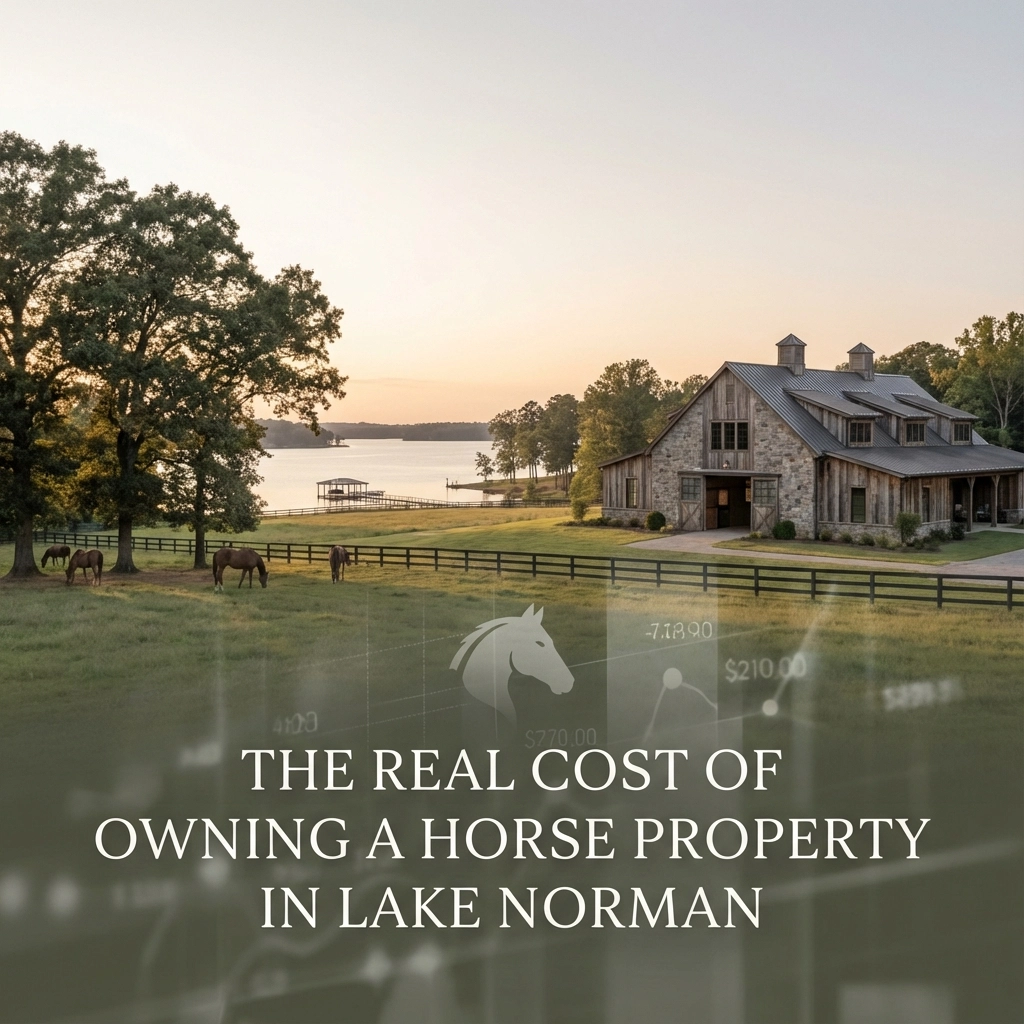
The recurring costs of a horse property near Lake Norman come down to property tax, hay and feed, hoof and veterinary care, insurance, and upkeep on fences, barns, footing, and equipment. Tax depends on the jurisdiction: for 2026, Iredell County's rate is $0.50 per $100 of assessed value and the Town of Mooresville adds $0.4836, while Mecklenburg County's rate for fiscal year 2027 is 49.27 cents per $100 before any town rate. The quantities are easier to pin down than the prices, so this guide gives you sourced quantities and a method to price them locally.
Property tax: rates as of October 2026
Iredell County publishes its rates in one table. Mecklenburg County announces its rate with the annual budget:
"The Mecklenburg County property tax rate remains at its current level of 49.27 cents per $100 of assessed valuation."
| Taxing unit | Rate per $100 | Notes |
|---|---|---|
| Iredell County | $0.50 | 2026 tax year |
| Town of Mooresville | $0.4836 | Added for parcels inside town limits |
| Mooresville school tax | $0.155 | Applies to parcels in that school tax district |
| Town of Davidson | $0.276 | As listed on Iredell's table |
| Mecklenburg County | $0.4927 | Fiscal year 2027, effective July 1, 2026 |
Iredell's table also lists fees: a county solid waste fee of $64 for 2026 and a Mooresville solid waste fee of $300 for 2026, along with fire district rates. Your tax bill shows which ones apply to your parcel.
Worked examples
Use a hypothetical assessed value of $800,000 so the math is easy to follow:
- Unincorporated Iredell County: $800,000 ÷ 100 × $0.50 = $4,000, plus any fire district rate and fees on the bill.
- Inside Mooresville and its school tax area: $0.50 + $0.4836 + $0.155 = $1.1386 per $100, so $800,000 ÷ 100 × $1.1386 = $9,108.80, plus fees.
- Mecklenburg County, before any town rate: $800,000 ÷ 100 × $0.4927 = $3,941.60. Cornelius, Davidson, and Huntersville each add their own rate; check the town's current adopted budget.
Two timing notes. First, Iredell County's tax office says:
"Next revaluation will be effective for January 1, 2027."
If you buy in Iredell now, expect a new assessed value for 2027 and do not budget off the seller's last bill. Second, qualifying farmland can be taxed at present-use value instead of market value, but horse farms face a specific income test. Our Mooresville area guide explains how that program works for horse owners.
Hay: the biggest feed line
N.C. Cooperative Extension in Polk County published a simple way to estimate winter hay. It assumes an 1,100-pound horse eats about 2 percent of its body weight in hay per day (22 pounds), a hay season from November through March (150 days), and good pasture the rest of the year. That is 3,300 pounds before waste. Adding 5 percent for indoor storage loss and 13 percent for feeding small squares on the ground brings it to 3,915 pounds:
"If you buy your hay by the ton, this would be 3915/2000 = almost 2 tons of hay per horse."
N.C. Cooperative Extension, Polk County Center: Calculating Winter Hay Needs
At 40 pounds a bale, that is about 98 bales per horse.
Pricing it
Hay prices change with weather and quality, so get quotes from local suppliers each summer. For an example price, a 2025 Polk County Extension article assumed fescue hay at about $9 per 50-pound bale, or $0.18 per pound. At that price, 3,915 pounds costs about $705 per horse per winter. If your horses have little pasture, the hay season is longer than 150 days and the number grows.
Cut the waste line
The same Extension article gives waste rates by feeding method: 13 percent with no feeder, 5 percent with a hay rack, and 3 percent with a basket feeder. Moving from ground feeding to a rack trims about 8 percentage points of waste, which on the example above is roughly 280 pounds of hay per horse per winter. Dry, covered storage matters too; the 5 percent storage figure assumes bales kept inside.
Hoof care and routine vet costs
"Horses usually need a trim every 6 to 8 weeks."
University of Minnesota Extension, Caring for your horse's hooves
The same page says hooves grow more slowly in winter, so the interval can stretch to 6 to 12 weeks then. Plan on roughly 6 to 9 farrier visits per horse per year, and multiply by your farrier's quote for a trim or for shoes.
For the vet line, start with the state's advice on equine infectious anemia:
"Test all horses for EIA every year, and at the time they enter a new premises."
NC Department of Agriculture and Consumer Services, Equine infectious anemia found in NC horses
Then list the items you know will recur:
- Coggins test. This is the common name for the test for equine infectious anemia (EIA). North Carolina State Parks require proof of a negative test no more than 12 months old for horses on their trails, and South Carolina State Parks require negative Coggins papers to use their equestrian facilities.
- Vaccinations, dental care, and deworming on the schedule your veterinarian sets.
- An emergency reserve. Colic and injuries do not follow a budget; decide in advance how much you would spend and whether insurance will carry part of it.
Insurance and liability
There is no standard price for farm insurance, so ask an agent who writes farm and equine policies to quote the pieces separately:
- The house, barn, and other farm structures, plus contents such as tack, hay, and equipment.
- Liability for visitors, and separate coverage if you board, teach, or host events.
- Care, custody, and control coverage if other people's horses live on your property.
- Optional equine mortality or major medical coverage on your own horses.
If you will board or teach, North Carolina's equine activity liability law treats operators of equine facilities as equine activity sponsors and requires them to post warning signs and use contract language before they can claim its protection. Budget for those, and have your attorney review your boarding contract.
Upkeep: fences, barns, footing, and equipment
These costs depend on what the farm has and its condition, so build them from a walk-through rather than a rule of thumb:
- Fencing: boards, posts, wire, gates, and electric chargers. Note the type and age of every run.
- Barn: roof, gutters, stall mats, doors, lighting, fans, and waterers.
- Footing: arena footing replacement and grading, and gravel for heavy-use areas.
- Pasture: lime, fertilizer, seed, and mowing, based on a soil test.
- Equipment: tractor, mower, spreader, and trailer maintenance, or the cost of hiring the work out.
- Manure: the same NCDA&CS release advises cleaning stalls regularly and disposing of manure away from where horses are stabled. That means a spreader, a removal service, or a compost plan.
Some conservation projects on established farms can qualify for cost share. In Iredell County, the Soil and Water Conservation District runs the North Carolina Agriculture Cost Share Program, which can cover up to 65 percent of the average cost of an approved best management practice. Ask before you build.
Utilities
Rural parcels often run on a private well and septic system, and Mooresville's Rural Conservation district is written for areas typically not served by water and sewer. Budget for well pump and pressure tank service, septic pumping, and the barn's electric bill for lights, fans, and heated waterers.
A budget worksheet you can fill in
| Item | How to estimate it | Where the quantity comes from |
|---|---|---|
| Property tax | Assessed value ÷ 100 × combined rate | County tax rate tables |
| Hay | Pounds per day × days × waste factor × price per pound | NC Extension hay method |
| Farrier | Visits per year × your farrier's quote | 6 to 8 week trim interval |
| Coggins | One test per horse per year, plus new arrivals | NCDA&CS guidance |
| Insurance | Separate quotes by coverage | Your agent |
| Upkeep | Itemized from a walk-through | Property condition |
Run your numbers through our horse farm cost calculator, and see our guide to horse farm costs for purchase-side costs. Buyers weighing lakefront against acreage should also read our Cornelius lake life guide, and our Mooresville area page covers the town.
If you want help pulling tax records and comparing carrying costs on specific properties, contact us.
Sources
- Mecklenburg County, FY2027 budget adoption news release
- Iredell County, Tax Rates
- N.C. Cooperative Extension, Polk County Center: Calculating Winter Hay Needs
- N.C. Cooperative Extension, Polk County Center: Present Use Value for Farm Property Tax Reduction
- University of Minnesota Extension, Caring for your horse's hooves
- NC Department of Agriculture and Consumer Services, Equine infectious anemia found in NC horses
- North Carolina General Assembly, G.S. 99E-1 Definitions
- North Carolina General Assembly, G.S. 99E-3 Warning required
- NC State Parks, Park Rules
- South Carolina State Parks, Equestrian Trails
- Iredell County Soil and Water Conservation District, North Carolina Agriculture Cost Share Program
- Town of Mooresville, Unified Development Ordinance (amended May 5, 2025)