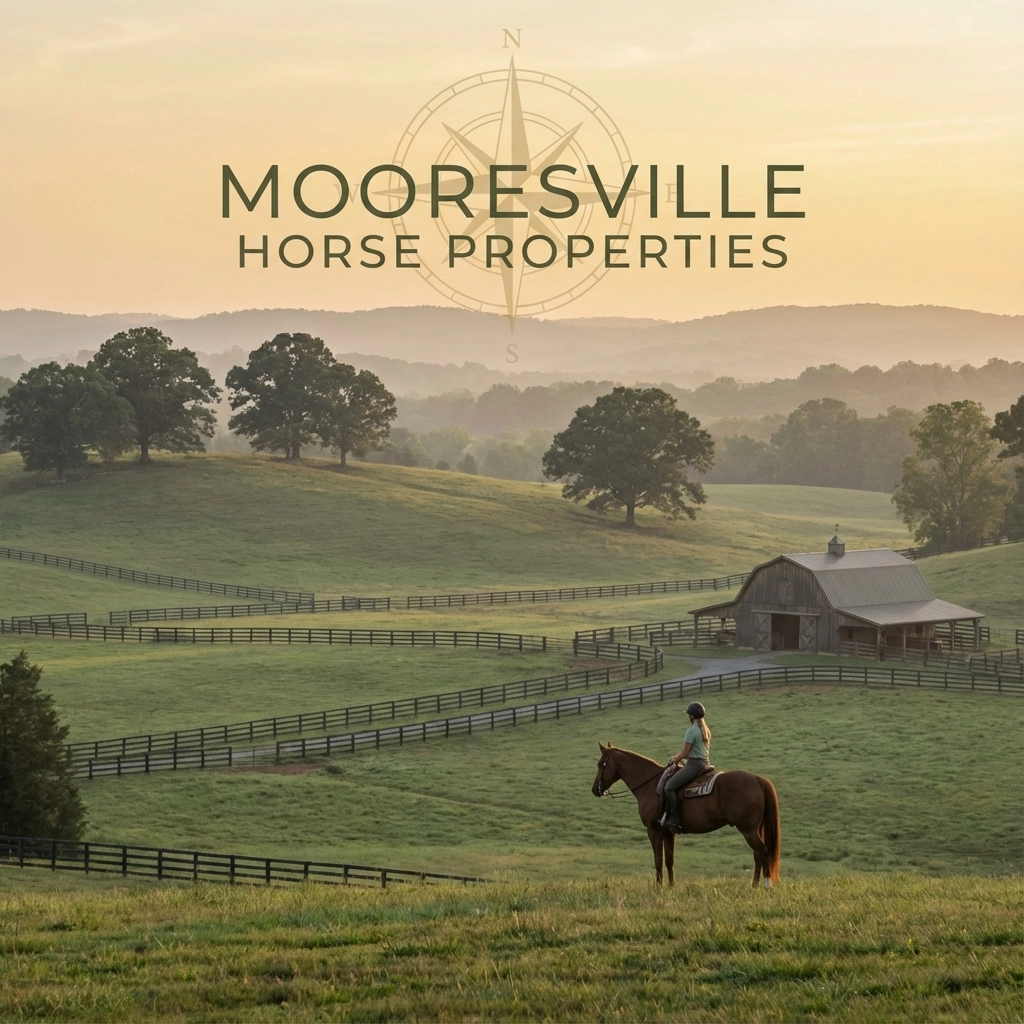
Mooresville is a town in Iredell County with its own zoning code, and the larger horse parcels are mainly in the town's Rural Conservation (RC) district and in unincorporated Iredell County outside the town. Iredell is a strong farm county, including for hay, and North Carolina's present-use value program can cut taxes on qualifying land, though horse farms have to plan for its income test.
First, a geography check
Mooresville is in Iredell County. It has nothing to do with Moore County, which is a separate county with its own rules. Any article that quotes Moore County zoning for a Mooresville property is wrong.
Within the Mooresville area, a parcel falls into one of three places:
| Where the parcel sits | Rulebook | Horse-related headline |
|---|---|---|
| Town of Mooresville limits | Town Unified Development Ordinance (UDO) | Farm use permitted by right in the RC district |
| Mooresville extraterritorial area (ETJ) | Town UDO | Operating bona fide farms exempt to the extent state law requires |
| Unincorporated Iredell County | Iredell County Land Development Code | Bona fide farms exempt; other horse uses follow the district |
The detailed horse rules for each, including how many horses a homeowner can keep, are in our guide to horse property zoning in Mooresville. This guide covers the lay of the land, taxes, and local programs.
Where the larger parcels are
Inside the town: the RC district
Mooresville's current UDO (amended May 5, 2025) created a Rural Conservation district that had no equivalent in the old ordinance. Its purpose statement is friendly to horse owners:
"Agricultural uses and other typical rural uses are generally appropriate."
Outside of a conservation subdivision, RC allows one home per acre on lots of at least one acre. The district is written for areas typically not served by water and sewer service, so ask early whether a parcel has public water and sewer or a well and septic system.
Outside the town: Iredell County's rural districts
Iredell County's Land Development Code includes A-C Agricultural Conservation, R-A Residential Agricultural, and RU-R Rural Residential districts. A practical way to find candidate land is to open the county's online GIS (which includes zoning, floodplain, and tax maps) and look at parcels in those districts, then check the tax record for present-use value status.
Farmland preservation districts
Iredell County maps voluntary farmland preservation districts and posts a notice for buyers:
"Iredell County has established farmland preservation districts to protect and preserve agriculture lands and activities."
The same notice warns that pesticide spraying, manure spreading, machinery and truck traffic, livestock operations, and sawing may happen in these districts at any time of day or night. For a horse buyer, a neighboring farm district can be a plus: it signals working land nearby rather than a future subdivision. Owners who enroll sign an agreement that bars non-farm use or development for at least 10 years, except for up to three lots. A district initially needs 25 or more acres of qualifying farmland, or must be within one mile of an existing district.
A county built on farming
"Iredell County consistently ranks in the top 10 in several farming commodities including: dairy, cattle, hay, and layers."
Hay is on that list, which matters for anyone feeding horses through the winter. Ask sellers who they buy hay from and who maintains their fencing, and get those names before closing.
Present-use value: how it works for horse farms
North Carolina's present-use value (PUV) program taxes qualifying farmland on its value as farmland instead of market value. The rules for agricultural land are in G.S. 105-277.3:
- The tract must include at least 10 acres in actual production.
- The land must have produced an average gross income of at least $1,000 over the three years before January 1 of the year the benefit is claimed.
- Gross income includes sales of agricultural products produced from the land and grazing fees for livestock.
- Individually owned land must also be the owner's residence, or have been owned by the owner or a relative for the four years before January 1, or meet a transfer exception.
Horse farms hit a specific snag. N.C. Cooperative Extension in Polk County explained it this way:
"Typically, horse farms have been harder to enroll, because the qualifying criteria of $1,000 of gross income per year must come from something produced on the farm, which doesn't include boarding or training fees."
N.C. Cooperative Extension, Polk County Center: Present Use Value for Farm Property Tax Reduction
The same article points to a path that can work:
"Grazing fees, however, have been included for several years now."
N.C. Cooperative Extension, Polk County Center: Present Use Value for Farm Property Tax Reduction
Its worked example values pasture forage at what it would cost as hay. Assuming fescue hay at about $9 per 50-pound bale, or $0.18 per pound, a 1,200-pound horse eating 2 percent of its body weight (24 pounds a day) on pasture for 250 days produces about $1,080 in grazing value. The article suggests boarding barns split invoices so the grazing portion is shown separately from stall and facility fees, and notes that you need three years of income to qualify.
What a buyer should ask about PUV
- Is the parcel enrolled now, and in which use (agricultural, horticultural, or forest)?
- How large are the deferred taxes? When land loses eligibility, the statute makes the deferred taxes for the preceding three fiscal years due.
- Will you continue a qualifying use? A new owner can keep the classification if the land continues to meet the requirements, but the deferred taxes stay a lien on the land.
- Who will document the income? Grazing records, hay sales receipts, and invoices that separate grazing from board all help.
Confirm the details with the Iredell County tax office and your CPA before closing. The county's tax office also notes that its next revaluation takes effect January 1, 2027, so assessed values on any parcel you buy now are due to change. Our post on the real cost of owning a horse property near Lake Norman walks through current tax rates.
Local programs for horse farm owners
Iredell Soil and Water Conservation District
The district handles local sign-up for the North Carolina Agriculture Cost Share Program, which the state Division of Soil and Water Conservation administers. The program helps established agricultural operations install best management practices that protect water quality, with cost share of up to 65 percent of the average cost of each practice. To apply, you must prove agricultural status with a Schedule F, a farm sales tax exemption certificate, or a qualifying forest management plan. The office is at 444 Bristol Drive in Statesville. The district's page also describes AgWRAP, a state cost-share program for practices that increase water supply for agricultural use; ask whether sign-up is open.
Iredell County Planning and Development
The county's agricultural development page says that deciding which properties qualify for the bona fide farm exemption, and which uses are exempt from zoning, requires looking at multiple criteria. Call the department (349 N. Center Street, Statesville) before you assume a barn or arena on county land is exempt.
Riding near Mooresville
Lake Norman State Park in Iredell County lists hiking and biking trails but not horseback riding. Mecklenburg County's park system offers public equestrian trails at Latta Nature Preserve in Huntersville, which the county says has 15 miles of them. Plan on trailering for trail rides.
Putting it together
- For a few horses on a home lot inside town, look at RC first and read the zoning post.
- For a working farm with pasture, look at unincorporated Iredell County land in the rural districts and check PUV status.
- For a boarding or lesson business, plan the income records and zoning approvals before you buy.
Browse current Mooresville acreage, our Mooresville area page, and the Iredell County overview. If you want help comparing parcels in town and county, contact us.
Sources
- Town of Mooresville, Unified Development Ordinance (amended May 5, 2025)
- Iredell County, Land Development Code
- Iredell County, GIS Mapping
- Iredell County, Farmland Preservation
- Iredell County, Agricultural Development
- Iredell County, Tax Rates
- Iredell County Soil and Water Conservation District, North Carolina Agriculture Cost Share Program
- Iredell County Soil and Water Conservation District, Agricultural Water Resources Assistance Program
- North Carolina General Assembly, G.S. 105-277.3 Agricultural, horticultural, and forestland
- North Carolina General Assembly, G.S. 105-277.4 Agricultural, horticultural, and forestland: application, appraisal, and deferred taxes
- N.C. Cooperative Extension, Polk County Center: Present Use Value for Farm Property Tax Reduction
- NC State Parks, Lake Norman State Park
- Mecklenburg County Park and Recreation, Hiking and Horseback Riding
- Mecklenburg County Blog, Latta Nature Preserve: What's There to Do?