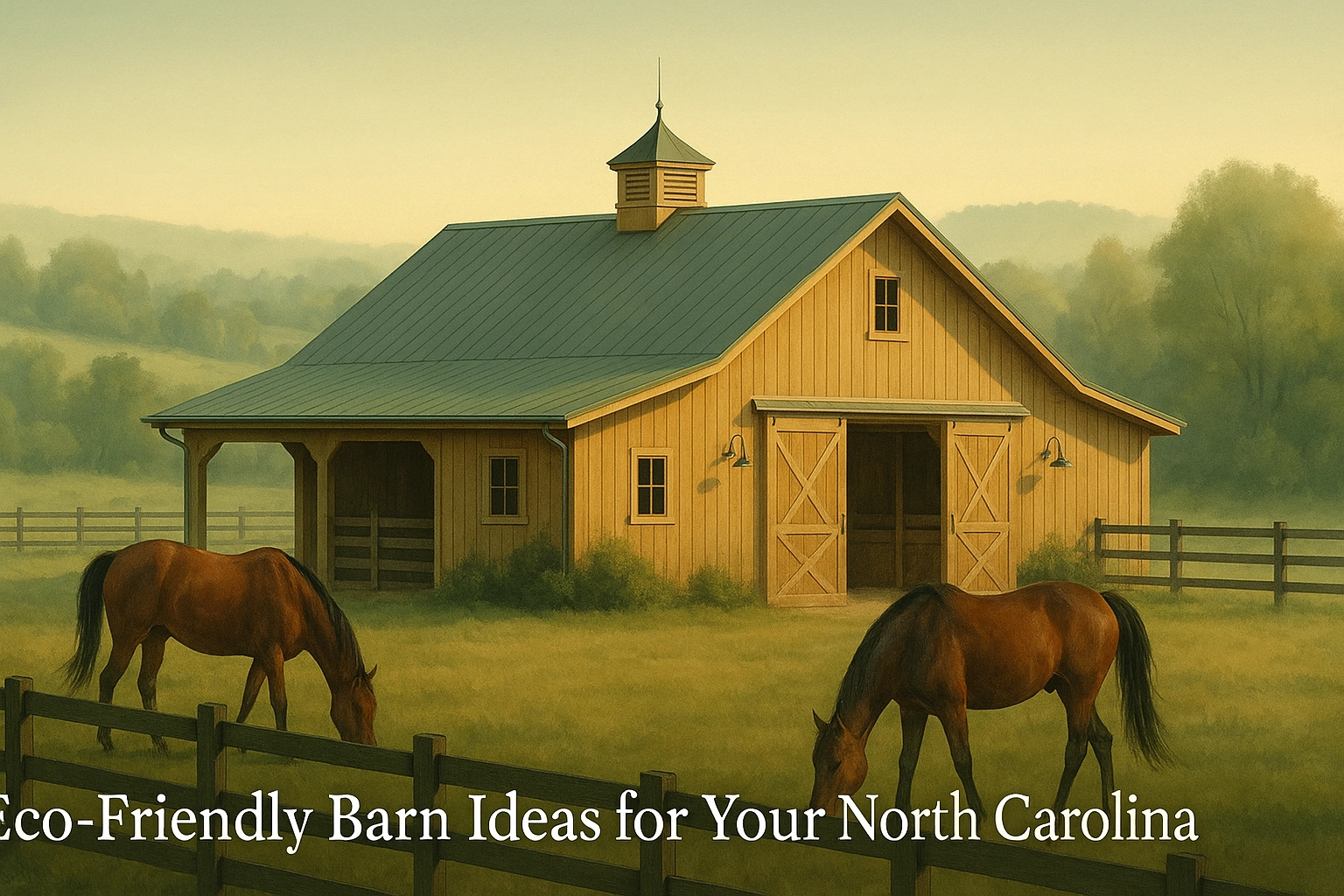
The eco-friendly barn upgrades that make sense on a North Carolina horse farm are the ones that also save labor and money: treat manure as fertilizer instead of waste, keep clean rainwater away from manure and mud, and design for daylight and natural airflow so you need fewer fans and lights. Be realistic about solar, since the federal home credit has ended. For established farms, the state's Agriculture Cost Share Program can pay most of the cost of several of these practices.
Start with the manure math
Penn State Extension's figures for a 1,000-pound horse show why manure planning comes first:
| Per stalled horse | Amount |
|---|---|
| Raw manure and urine per day | About 51 pounds |
| Total stall waste removed per day, with bedding | About 60 to 70 pounds |
| Stall waste per year | About 12 tons, 8.5 of it manure |
| Nutrients in that 8.5 tons | About 102 lb nitrogen, 43 lb phosphate, 77 lb potash |
Penn State adds that one horse's annual stall waste would fill its own 12-by-12 stall about 6 feet deep.
A worked example. Four stalled horses produce roughly 48 tons of stall waste a year. The manure in it carries about 408 pounds of nitrogen, 172 pounds of phosphate, and 308 pounds of potash. Penn State cautions that manure nutrient values vary widely, but the point stands: that's real fertilizer value, and also a real pollution risk if the pile sits next to a creek or well.
Compost it or keep it dry
Penn State's guidance points to two ways to handle a pile on the farm. Composting happens naturally when stall waste breaks down with oxygen and stays relatively moist, above 50 percent moisture. Because it's aerobic, it doesn't produce the offensive odors of a wet, airless pile. A storage pile you don't plan to compost should stay as dry as possible, below 50 percent moisture, to discourage fly egg-laying.
For fly control, the guidance is specific: remove manure from the farm at least every 7 days during fly breeding season, or run a properly managed composting operation. Add new waste to the pile as a block rather than spreading it over the top, which creates more fresh surface for flies.
Put the pile in the right place
Penn State reprints commonly recommended minimum separation distances for composting and manure handling from the On-Farm Composting Handbook:
| Sensitive area | Recommended minimum distance |
|---|---|
| Property line | 50 to 100 feet |
| Residence or business | 200 to 500 feet |
| Private well or drinking water source | 100 to 200 feet |
| Streams, ponds, lakes, wetlands | 100 to 200 feet |
Place the pile downwind of the barn and house, screen it from view, and cover it with a roof or tarp to cut down on leachate, the brown liquid that drains from wet piles.
Spread it with a soil test in hand
Manure adds phosphorus and potassium along with nitrogen, so pull an NCDA&CS soil test before spreading. Our soil-first pasture management guide explains how. Penn State notes that nitrate nitrogen is the component with the most pollution potential because it moves freely in soil.
Choose bedding with the end in mind
Bedding makes up most of the volume you haul. Penn State says soiled bedding removed during cleaning is nearly twice the volume of the manure itself, and that bedding types differ in how well they compost and sell. It also warns that walnut shavings cause founder, so all hardwood shavings should be avoided in case walnut is mixed in.
Keep clean water clean
"Many stables and indoor riding arenas do not have gutters and downspouts, causing substantial runoff from these buildings."
Penn State recommends gutters and downspouts that carry roof water away from foundations and around the manure storage, and diverting surface runoff away from the pile. That one change reduces mud at doorways, keeps rain out of the manure, and cuts leachate.
The volume is larger than most people expect. One inch of rain on 1,000 square feet of roof is about 623 gallons (1,000 square feet times 1/12 foot is 83.3 cubic feet, at 7.48 gallons per cubic foot). A 36-by-60-foot barn roof (2,160 square feet) sheds roughly 1,350 gallons per inch of rain before losses. If you collect it in tanks, it can serve non-drinking uses like arena dust control or rinsing equipment.
Two other runoff fixes:
- Stabilize heavy-use areas. Gates, troughs, and hay feeders turn into mud first. Surfacing them with stone or concrete keeps soil out of runoff.
- Build a rainy-day paddock. Penn State suggests an ungrassed exercise lot on high ground, with stone dust footing to cut mud and collect manure, surrounded by established sod to catch runoff.
If the farm has a creek or sits near Lake Norman, buffer rules may also apply. Our post on water on a North Carolina horse property covers those.
Light and air without the electric bill
Penn State Extension says natural ventilation, driven by wind and rising warm air, is adequate for horses, and that mechanical ventilation is more expensive to install and maintain and isn't commonly needed in horse stables.
"Each stall should have direct access to fresh air openings that are open year-round."
Its design targets:
- Air changes. Provide 4 to 8 air changes per hour to limit mold spores, condensation, moisture, odor, and ammonia.
- Permanent openings. At least 1 square foot of year-round opening per stall, ideally a continuous slot at the eave. The cold-climate minimum is 1 inch of continuous slot for each 10 feet of building width.
- Ridge vent. A ridge opening lets warm, moist air escape at the peak. Sidewall openings matter more if you can only have one.
- Hot-weather openings. Windows or doors equal to 5 to 10 percent of each stall's floor area. For a 12-by-12 stall, that's roughly a 3-by-2.5-foot window at 5 percent.
- Fans. Circulation fans only move the air already in the barn. Penn State says a properly designed stable should virtually eliminate the need for them.
For daylight, Penn State's stall design guidance calls for at least 4 square feet of window per stall, with glass out of reach (generally above 7 feet) or protected by bars or mesh.
Check air quality where the horse breathes. Penn State notes most dust and ammonia sit near the bedding, and that a breezy aisle can hide stuffy stalls.
Solar: what's real in 2026
"The credit is not available for any property placed in service after December 31, 2025."
That 30 percent federal credit for home solar, which older articles may still mention, is gone for new systems. Solar on a barn used in a farm business is taxed differently, and the rules have changed, so ask a CPA what applies before you count on any federal incentive.
Small solar still pays off around a horse farm. Penn State notes solar chargers can power temporary electric fencing for rotational grazing, which saves running power to the back paddocks. The NC Agriculture Cost Share Program lists solar fence chargers as a component of its livestock exclusion fencing practice.
Paying for it: cost-share in North Carolina
The NC Agriculture Cost Share Program is administered by the Soil and Water Conservation Commission through local soil and water conservation districts. It's open to landowners or renters who have operated a bona fide farm for more than three years. Practices on its list that fit horse farms include:
| Practice | What it covers | Maintenance period |
|---|---|---|
| Manure composting facility | Treating and storing manure as compost | 10 years |
| Dry stack | A structure for temporary manure storage | 10 years |
| Rooftop runoff management | Guttering, collection boxes, drip-line stabilization | 10 years |
| Heavy use area protection | Surfacing high-traffic animal areas | 10 years |
| Livestock exclusion fencing | Fencing animals out of streams | 10 years |
For each of these, NCDA&CS lists cost share at 75 or 90 percent of average cost. Farms enrolled in an Enhanced Voluntary Agricultural District qualify for the higher rate; see our post on conservation easements and farmland districts.
Federal help runs through USDA. Farmers.gov says the Natural Resources Conservation Service and Farm Service Agency offer cost-share financial assistance and technical help, starting with a visit to your local USDA Service Center, and that applications are generally ranked by local resource concerns.
Questions to ask when touring an eco-friendly barn
- Where does manure go, and how far is the pile from the well, the house, and any creek?
- Does the barn have gutters and downspouts, and where does roof water end up?
- Are there eave and ridge openings, and a window in each stall?
- Are heavy-use areas surfaced, or do gates and troughs turn to mud?
- Is the solar system owned or leased, and what did it cost to install?
- Were any practices installed under a cost-share contract? If so, what maintenance does it require?
For barn designs that combine living space and stalls, see our barn homes page. If you want help evaluating a farm's barn and land, contact us.
Sources
- Penn State Extension, Horse Stable Manure Management
- Penn State Extension, Horse Stable Ventilation
- Penn State Extension, Horse Stall Design
- Penn State Extension, How to Make Rotational Grazing Work on Your Horse Farm
- IRS, Residential Clean Energy Credit
- NCDA&CS Division of Soil and Water Conservation, Agriculture Cost Share Program
- NCDA&CS, ACSP BMP: Manure Composting Facility
- NCDA&CS, ACSP BMP: Dry Stack
- NCDA&CS, ACSP BMP: Rooftop Runoff Management
- NCDA&CS, ACSP BMP: Heavy Use Area Protection
- NCDA&CS, ACSP BMP: Livestock Exclusion Fencing
- NC General Assembly, Chapter 106, Article 61
- USDA Farmers.gov, Conservation