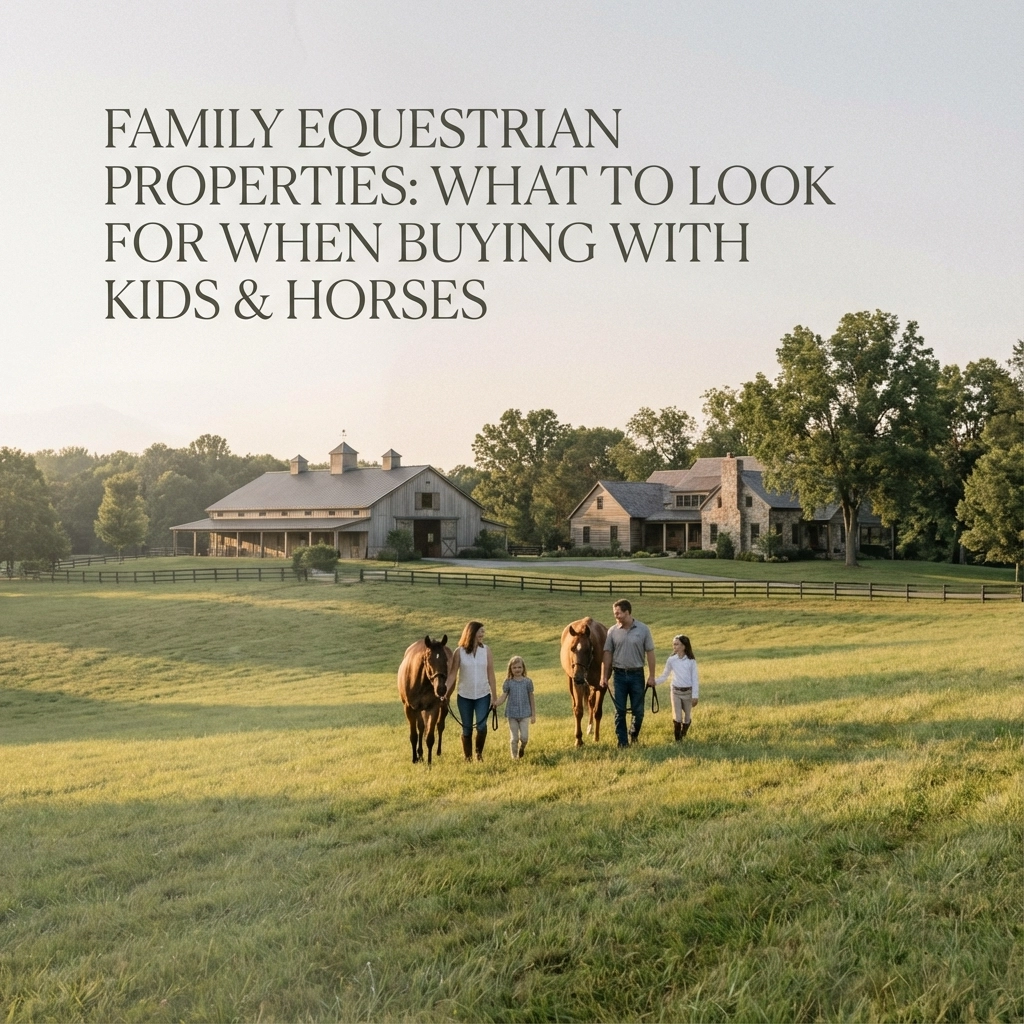
A family horse property should keep young children physically separated from the barn and equipment area, use fencing and gates a child cannot easily get through, and sit in the school assignment zone you want. It should also have enough land and budget for the horses your family will have in five years, not just the first pony. Check schools by street address and plan the layout before you fall for the barn.
This guide covers what is different when you buy with kids. For the general buying process, see our guide to buying a horse farm.
Start with the layout: where will the kids play?
On a farm, the house, the yard, the barn, and the equipment shed are often a few steps apart. Child safety researchers recommend drawing a line between them:
"Ideally, non-working children should be physically separated from the occupational and environmental hazards associated with agricultural worksites."
National Children's Center for Rural and Agricultural Health and Safety, Safe Play Areas
Nationwide Children's Hospital lists falls, drowning, large animals, machinery, and tractors among the common causes of farm injuries for children under 6. It also notes that most farms do not have fenced play areas for young children. Use that list when you tour:
- Is there a fenceable yard between the house and the barn? A yard with its own gate gives young kids a place to play that is not a paddock.
- Can you see the paddocks and barn door from the kitchen or back porch? Sightlines matter more than distance.
- Is there a pond? If it sits near the house or the play yard, price a fence.
- Where do the tractor and trailers move? The driveway to the barn should not cut through the play yard.
- Where is the manure pile? It should be away from play space and downhill from the well.
Fencing and gates that work with kids
Horse fencing has to hold horses, but on a family farm it also has to stop small children from wandering in. University of Georgia Extension guidance for horse fencing starts with visibility. It advises owners to "avoid barbed and high-tensile wire where possible as they are difficult for horses to see." For board fences, it recommends a total height of 60 inches on the perimeter and 54 inches for cross fencing, with the bottom board 6 inches off the ground.
Gates get the most use, by adults with full hands and by curious kids. The same guidance says a gate should be just as tall as the fence, recommends a 4 to 5 foot handler gate for walking horses in and out, and suggests latches one person can open, close, and lock with one hand, since the other hand is usually holding a horse or a bucket. UGA also warns against diagonal cross-brace wood gates, where legs, feet, or heads can get caught, and suggests setting road gates back at least 40 feet so you can pull a trailer off the road to open them. On a tour, open every gate yourself and note which latches a child could work.
A barn kids can help in
Children learn by doing chores, so look for a barn layout that makes chores manageable: a tack room they can reach, a clear aisle, and hay storage that does not require climbing. Fire safety, electrical, and stall basics are covered in our post on barn safety for new North Carolina horse property owners.
Riding gear is part of the budget. Utah State University Extension recommends helmets certified to ASTM and SEI standards and gives two rules worth knowing:
"Each rider should have a helmet that is properly fitted to his/her head for maximum safety. Therefore, equestrian helmets should not be shared among riders."
Utah State University Extension, Helmets, Heads, and Health for Horse Enthusiasts
The same publication says helmets should be replaced after a maximum of 5 years or after a major impact. With growing kids, plan on new sizes anyway.
Check schools by address, not by town
School assignment follows the street address, and around Charlotte the lines do not always match town names or ZIP codes. Near Mooresville, for example, an address can fall in the Mooresville Graded School District or in Iredell-Statesville Schools. The Mooresville Graded School District's zoning page links to its "Find My School" lookup and to boundary maps for both districts, and it states the rule plainly:
"You must attend your zoned school based on your address of domicile."
Before you make an offer, run the exact address through the district's lookup tool, and call the district if the farm sits near a boundary. Ask about bus service too. Rural driveways can be long, and pickup points vary.
Youth horse programs close to home
A farm makes it easy for kids to ride every day, and a club gives them instruction, friends, and goals. North Carolina's 4-H horse program runs through NC State Extension and county Extension offices:
"A nationally respected and highly diversified 4-H Horse Program provides horse-owning and non-horse-owning youth with training in basic horse science and horsemanship."
NC State Extension lists horse bowl, hippology, judging, stable management events, county, district, and state horse shows, camps, and trail rides among the program's activities. To find a club, NC State suggests contacting the 4-H agent at the Extension center for your county, and it notes that youth can also join clubs in neighboring counties. That matters if you buy in one county and your child's friends ride in another.
Plan for the herd you will have in five years
Families often buy for one pony and end up with three horses: a lesson-ready pony for the youngest, a bigger horse as a child grows, and one for a parent. Before you buy, ask:
- Is there room for more paddocks and a run-in shed without crowding the house or the well?
- Does the barn have, or could it add, stalls for a full-size horse?
- Is there a flat spot for a riding area? A small dressage arena is 66 by 132 feet, according to University of Kentucky Extension.
- Do the covenants or zoning allow more horses? Check the recorded restrictions and the planning office, not the listing.
Questions to ask on a family tour
Bring these to every showing, along with the usual questions about the house:
- How fast is traffic on the road out front, and can kids wait for the bus somewhere safe?
- Does cell service work at the barn and in the far paddocks?
- Which fences and gates are newest, and who installed them?
- Where is hay stored, and can a child climb into the loft?
- Is the pond or creek fenced, and how deep does it get?
- Do neighbors keep dogs, livestock, or equipment near the shared fence line?
- Where is the closest large animal veterinarian, and who did the seller use?
- Are there recorded covenants that limit the number of horses, outbuildings, or fencing styles?
Write down the answers. They are easy to forget after the fourth farm in a day.
Budget for feed and the extras
Hay is the steady cost. University of Minnesota Extension says most horses should consume 2% of their body weight in hay each day. For an animal with no pasture, that works out to:
| Animal | Body weight | Hay per day | Hay per year (no pasture) |
|---|---|---|---|
| Pony | 500 lb | 10 lb | about 1.8 tons |
| Horse | 1,000 lb | 20 lb | about 3.7 tons |
Good pasture lowers those numbers for much of the year. Add bedding, farrier visits, vet care, lessons, helmets, boots, show fees, and fence repairs. Our horse farm cost calculator helps put the farm side of the budget together. Ask your insurance agent how your homeowner's policy treats horses and visiting riders before you close.
If you are touring farms with your family and want help sorting out schools, layout, and covenants, contact us.
Sources
- National Children's Center for Rural and Agricultural Health and Safety, Safe Play Areas
- Nationwide Children's Hospital, Farm Safety
- University of Georgia Extension, Fencing for Horses
- Utah State University Extension, Helmets, Heads, and Health for Horse Enthusiasts
- Mooresville Graded School District, Zoning
- NC State Extension, Equine Husbandry
- NC State Extension, Finding a County 4-H Horse Club
- University of Kentucky Cooperative Extension, ID-259 Suitable Spaces for Indoor Horse Activities
- University of Minnesota Extension, Hay in Horse Diets