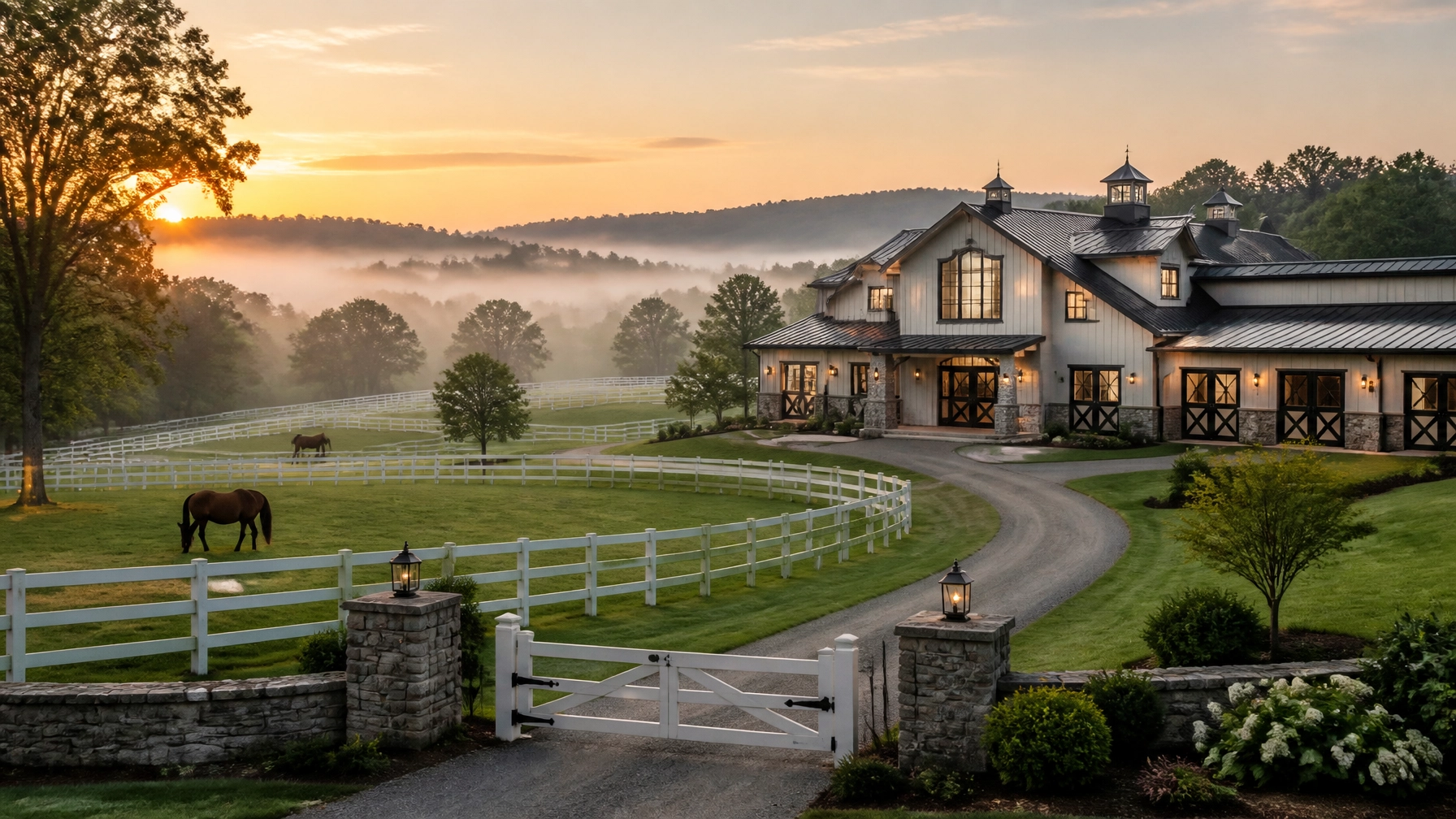
A private farm gives you control and privacy, and you carry every cost and decision yourself. An equestrian community trades some of that control for shared amenities, riding neighbors, and rules that protect the setting. Those rules come with dues, enforcement powers, and the chance that owners vote to change them, so the deciding step is reading the governing documents before you commit.
The trade-offs at a glance
| Factor | Private farm | Equestrian community |
|---|---|---|
| Ongoing costs | All upkeep is yours | Your own lot plus dues and any special assessments |
| Amenities | Whatever you build or haul to | Shared arena, trails, or barn, depending on the community |
| Rules | Zoning and your own choices | Zoning plus covenants, rules, and design review |
| Privacy | You decide who comes and goes | Neighbors share roads, trails, and facilities |
| Horse health | You control which horses arrive | Shared facilities mix horses from many barns |
| Resale | Depends on the farm and local sales | Also depends on the community's rules, dues, and upkeep |
Three kinds of equestrian community
The label covers very different setups, and the differences matter more than the name.
- Horse-lot subdivisions. Recorded covenants allow horses on individual lots. Each owner builds and maintains a barn and fence, and there may be few or no shared facilities.
- Amenity communities. An owners' association or an operator runs shared facilities such as an arena, trails, or a community barn. Dues fund them.
- Trail-association areas. Some horse country works without an HOA at all. In Polk County, the Foothills Equestrian Trails Association describes itself as an alliance of rural landowners and riders. Its trails are on private property and open only to members for horseback riding, and membership is open to riders who own property, reside, or board a horse in Polk County, NC, or in Landrum or Campobello, SC. Our Tryon buyer's guide explains how that trail access works in practice.
A neighborhood's name proves nothing about horses. Confirm in the recorded declaration that horses are allowed on the lot you're considering, and how many. Our guide to equestrian communities and our overview of horse-friendly areas near Charlotte are good starting points for where to look.
Costs: dues, special assessments, and liens
On a private farm, the bills are yours alone. In a community, you pay for your own lot and a share of the common costs, and the association has real collection tools.
North Carolina's residential property disclosure law, which covers most home sales, requires a statement on whether the property is subject to an owners' association. That statement must cover the regular dues, whether any special assessments have been approved, any pending lawsuits or unsatisfied judgments involving the association, and any fees charged when the lot is transferred. Read it closely, then ask for the association's budget and reserve study.
Unpaid dues don't stay a billing issue for long. Under the Planned Community Act, an assessment unpaid for 30 days or longer becomes a lien once the association files a claim of lien, and the first page of that claim must carry this statement:
"THIS DOCUMENT CONSTITUTES A LIEN AGAINST YOUR PROPERTY, AND IF THE LIEN IS NOT PAID, THE HOMEOWNERS ASSOCIATION MAY PROCEED WITH FORECLOSURE AGAINST YOUR PROPERTY IN LIKE MANNER AS A MORTGAGE UNDER NORTH CAROLINA LAW."
Fines can add up too. Unless the declaration sets its own procedure, G.S. 47F-3-107.1 requires a hearing first, and then allows a fine of up to $100 a day for a continuing violation. Those fines are secured by the same lien.
Shared horse facilities carry their own costs. Ask what the dues actually cover: arena footing replacement, trail maintenance, insurance on a community barn, staff. Ask when those items were last done and whether money is set aside for the next time.
Rules: read them as if you will live under them for decades
Covenants in horse communities often address the details that matter most to riders. When you read the documents, look for:
- How many horses each lot or acre may keep
- Design approval for barns, run-in sheds, and arenas
- Fence materials, colors, and heights
- Manure storage and removal
- Whether boarding, lessons, or other commercial use is allowed
- Where trailers and equipment may be parked
- Who may ride shared trails, including guests
Then remember that the rules can change. For communities covered by the Planned Community Act:
"the declaration may be amended only by affirmative vote or written agreement signed by lot owners of lots to which at least sixty-seven percent (67%) of the votes in the association are allocated"
The statute allows a declaration to require a larger majority. Either way, owners can vote to tighten horse rules, or loosen them, after you buy. Ask whether any amendments are being discussed, and read the last year of board minutes.
Size matters too. The Planned Community Act generally does not apply to communities created on or after January 1, 1999, that have no more than 20 lots, unless the declaration says it does. In a small equestrian subdivision, the declaration itself may be close to the whole rulebook, so have a real estate attorney read it.
Shared barns and arenas: horse health and liability
A shared facility means horses from many places sharing aisles, arenas, and water. North Carolina gives the State Board of Agriculture broad power over equine infectious anemia, including:
"authority to require the owner, operator or person in charge of shows, sales, public stables and other public places to require proof of freedom from equine infectious anemia before any animal is permitted to remain on the premises"
Ask any community with a shared barn or arena what it requires of arriving horses, such as a current Coggins test, vaccinations, or a quarantine period, and how it enforces those rules. On a private farm, those decisions are yours.
Ask about liability as well: who insures the common arena and trails, whether riders sign waivers, and whether trainers may teach on common property.
Privacy and control on a private farm
A private farm lets you set your own hours, guests, horse numbers, and building plans, within zoning. The trade-off is that you pay for everything, and you have no say over what happens on the land next door. Before you buy, ask the planning office what the zoning and land use plan allow on neighboring tracts.
Riding is the other gap. Without community trails, you may be hauling to ride. Our guide to public riding trails near Charlotte shows where riders go.
Resale
Neither option sells itself. A private farm's value depends on its facilities and on recent sales of similar farms nearby. A community lot also depends on how well the association maintains shared facilities, what the dues are, and how its rules fit the next buyer. Strict rules can protect the setting that buyers want, but they can also rule out buyers with a different plan, such as someone who wants to board horses for income.
Documents to request before you decide
For any community property, ask for:
- The recorded declaration, bylaws, and any amendments
- Rules and regulations, including equestrian facility rules
- Architectural or design guidelines
- The current budget and the most recent reserve study
- Board minutes from the past 12 months
- The owners' association disclosure, including approved special assessments and pending lawsuits
- Proof of insurance on shared facilities
If you'd like help comparing a private farm with a community property, contact us.
Sources
- Foothills Equestrian Trails Association, Home
- NC General Assembly, G.S. 47E-4: Required disclosures
- NC General Assembly, G.S. 47F-3-116: Lien for sums due the association; enforcement
- NC General Assembly, G.S. 47F-3-107.1: Procedures for fines and suspension of planned community privileges or services
- NC General Assembly, G.S. 47F-2-117: Amendment of declaration
- NC General Assembly, G.S. 47F-1-102: Applicability
- NC General Assembly, G.S. 106-405.17: Rules and regulations (equine infectious anemia)