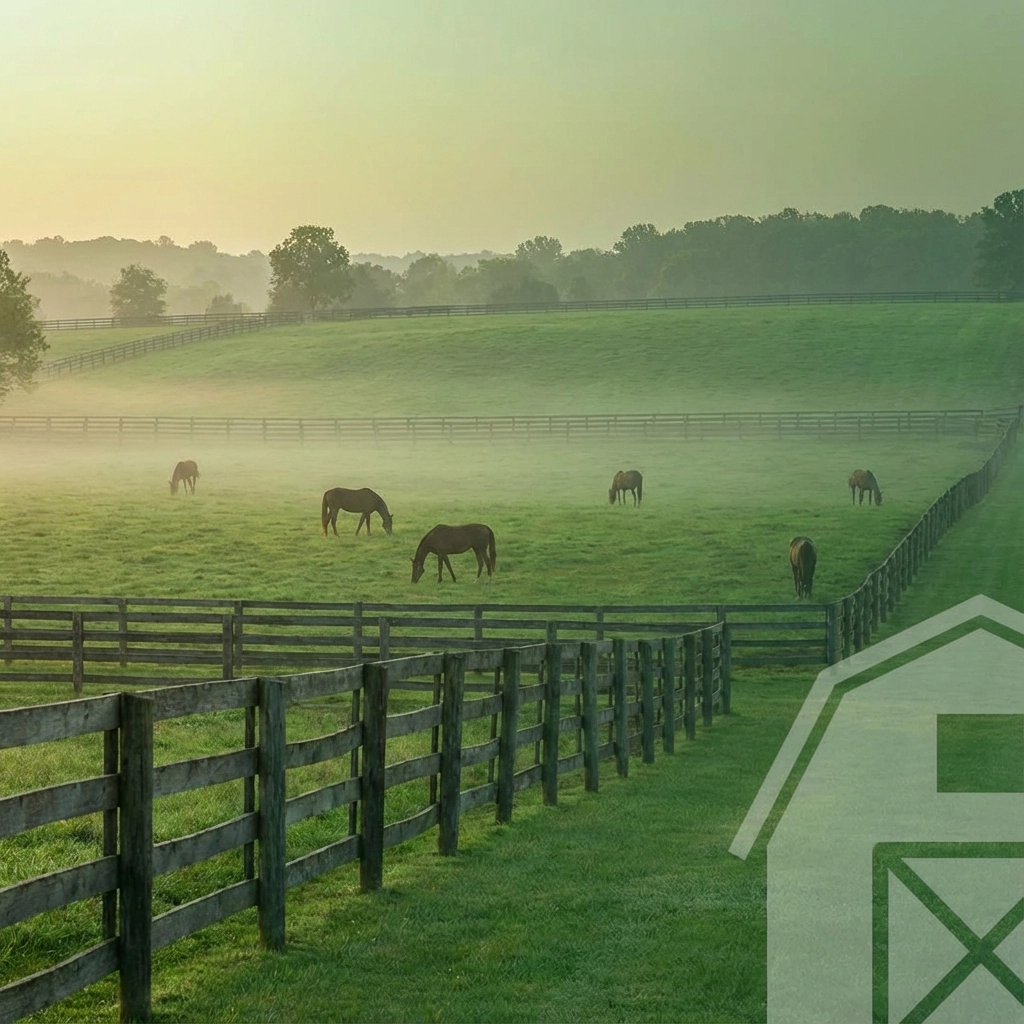
A North Carolina horse farm can earn money from boarding, lessons, training, clinics and events, and hay or pasture leases. State law treats boarding and training horses as agriculture, which helps with zoning, sales tax, property tax, and nuisance suits. But each income stream comes with its own rules, and the IRS has its own test for whether the operation is a business or a hobby.
This post walks through each option and what to check first. It is general information, not legal or tax advice. Confirm the details for your parcel with the county planning office, a North Carolina attorney, and a CPA.
Where North Carolina law names horse boarding
North Carolina writes horse boarding into several statutes, and each one matters to income:
| Statute | What it says about horses | Why it matters |
|---|---|---|
| G.S. 106-581.1 | Agriculture includes training and boarding horses | Feeds the county zoning exemption in G.S. 160D-903 |
| G.S. 105-277.2 | PUV agricultural land covers boarding and training | Property tax at present-use value |
| G.S. 105-164.13E | A qualifying farmer includes "a person who boards horses" | Farm sales tax exemption certificate |
| G.S. 106-701 | Right to Farm Act covers boarding and training | Limits on nuisance suits |
| G.S. 113A-52.01 | Sediment control law exempts boarding and training | Agricultural land disturbance exemption |
The property tax definition is the clearest example:
"For purposes of this definition, the commercial production or growing of animals includes the rearing, feeding, training, caring, boarding, and managing of horses."
Two limits apply. The zoning exemption covers county zoning and town ETJs, not land inside town limits. And it does not cover "nonfarm purposes", which is where events and retail can run into trouble.
Boarding
Boarding is the income stream most tied to the land, and North Carolina gives boarding operators a specific tool for unpaid bills:
"Any person engaged in the business of boarding animals has a lien on the animals boarded for reasonable charges for such boarding which are contracted for with an owner or legal possessor of the animal."
A lien works best with a clear written contract, so the boarding agreement should state rates, what is included, and when charges are due. Enforcing a lien has its own procedures, which is a question for an attorney.
Plan for animal health rules too. A North Carolina Department of Agriculture rule requires a negative Equine Infectious Anemia (Coggins) test within the previous 12 months for horses at any public place used for exhibition, recreation, or assembly:
"The person in charge of any public place where equine are brought or kept for exhibition, recreation or assembly shall not permit an equine to remain on the premises without the test required by this Rule."
NC Office of Administrative Hearings, 02 NCAC 52B .0406 EIA Test Required
Whether your barn counts as a "public place" is a question for the NCDA&CS Veterinary Division. Requiring a current Coggins from every boarder is simple either way.
Budget the hay before the board rate. New Mexico State University Extension calculates that an 1,100-pound horse eating 2% of body weight needs about 24.4 pounds of hay a day, or about 4.5 tons a year with no pasture. Twelve stalled horses at that rate need about 54 tons a year. Pasture lowers that number, but it is the first line in a boarding budget. Our horse farm costs guide covers the other lines.
Lessons and training
Instruction changes your legal role. Under G.S. 99E-1, anyone paid to instruct a rider is an "equine professional", and G.S. 99E-3 requires equine professionals and activity sponsors to post the state's warning sign and print the warning in their contracts. Without the sign and contract language, the liability protection is lost. Our training facility buyer's questions cover the sign wording, insurance, and contract review in detail.
Zoning for lessons is less settled than for boarding. G.S. 106-581.1 names training and boarding horses. The building code exemption in G.S. 143-138(b4) separately names "the instruction and training of riders", but the zoning statute does not use that phrase. The UNC School of Government notes that "the precise scope of the bona fide farm exemption is complicated." If lessons will be a large part of the business, ask the county zoning administrator for a written answer before you buy.
Clinics, shows, and events
Events bring the most people and the most rules.
- Zoning. G.S. 160D-903(a)(4) treats a building used for agritourism, which the statute defines to include "equestrian activities", as a bona fide farm purpose only if the owner holds a farm sales tax exemption certificate or the property is enrolled in present-use value. Without one of those, an event barn may need county approval.
- Liability. Agritourism has its own statute. G.S. 99E-32 requires a separate warning sign at the entrance and at the activity site, in black letters at least three quarters of an inch tall.
- Seating. Bleachers and grandstands in an exempt farm building still need an annual safety inspection under G.S. 143-138(b4).
- Restrooms. Septic design flows for events are based on attendance. Under 15A NCAC 18E .0401, an event center is designed at 5 gallons per person for events up to 4 hours with toilets and hand sinks. Portable toilets for a single show are a different question than a permanent clubhouse, so ask the county health department.
Hay sales and pasture leases
Selling hay from your own fields and renting pasture are quieter income streams, and they count toward present-use value. Under G.S. 105-277.3, agricultural land generally needs at least 10 acres in actual production and an average gross income of at least $1,000 over the three years before the year you apply. Gross income includes sales of agricultural products from the land and "grazing fees for livestock."
Two more PUV rules matter to buyers. The land must be the owner's residence or have been owned by the owner or a relative for the four years before January 1 of the application year, unless a continued-use exception applies. And if the land later loses eligibility, the deferred taxes for the preceding three fiscal years come due under G.S. 105-277.4(c), with interest running from the dates those taxes would originally have been due (G.S. 105-277.1F).
How the IRS looks at horse income
The IRS does not care whether the county calls you a farm. It asks whether you operate for profit. Publication 225, the Farmer's Tax Guide, explains the presumption:
"Activities that consist primarily of breeding, training, showing, or racing horses are presumed carried on for profit if they produced a profit in at least 2 of the last 7 tax years, including the current year."
Other farming activities use a test of 3 profitable years out of 5. Boarding is not on the horse list, so ask your CPA which test fits your mix of boarding, training, and lessons. If you fail the test, the IRS weighs factors such as whether you run the farm "in a businesslike manner", keep up the time and effort, and change methods to improve profitability. A new operation can file Form 5213 to postpone the IRS determination until the 5-year (or 7-year) period has passed.
Separate bank accounts, written contracts, a business plan, and good records are the kind of evidence that shows a businesslike operation.
A checklist before you buy a farm for income
- Confirm whether the parcel is under county zoning, a town's ETJ, or town limits.
- Ask which proof of farm status exists: sales tax certificate, PUV listing, or Schedule F.
- Get the seller's boarding and lesson contracts and the last two to three years of income records.
- Count stalls, paddocks, and acres of usable pasture, and price the hay you will need to buy.
- Check septic permits and well capacity for staff, boarders, and students.
- Get quotes for commercial equine liability and care, custody, and control coverage.
- Ask your CPA how the IRS and the state will treat the income.
Owning the land costs money whether or not the barn is full. Our post on the real cost of owning a horse property near Lake Norman breaks down those carrying costs.
If you are weighing a farm with an existing boarding or lesson business, contact us and we can help you gather the records to review.
Sources
- North Carolina General Statutes, G.S. 106-581.1 Agriculture defined
- North Carolina General Statutes, G.S. 160D-903 Agricultural uses
- North Carolina General Statutes, G.S. 105-277.2 Definitions (present-use value)
- North Carolina General Statutes, G.S. 105-277.3 Agricultural, horticultural, and forestland classifications
- North Carolina General Statutes, G.S. 105-277.4 Application and deferred taxes
- North Carolina General Statutes, G.S. 105-277.1F Collection of deferred taxes
- North Carolina General Statutes, G.S. 105-164.13E Exemption for farmers
- North Carolina General Statutes, G.S. 106-701 Right to farm defense; nuisance actions
- North Carolina General Statutes, G.S. 113A-52.01 Applicability of this Article
- North Carolina General Statutes, G.S. 44A-2 Persons entitled to lien on personal property
- NC Office of Administrative Hearings, 02 NCAC 52B .0406 EIA Test Required
- New Mexico State University, Hay Feeding Management Strategies as Cost-control Measures on Horse Farms
- North Carolina General Statutes, G.S. 99E-1 Definitions
- North Carolina General Statutes, G.S. 99E-3 Warning required
- North Carolina General Statutes, G.S. 143-138 North Carolina State Building Code
- UNC School of Government, Bona Fide Farms and Development Regulations
- North Carolina General Statutes, G.S. 99E-32 Warning required (agritourism)
- NC Office of Administrative Hearings, 15A NCAC 18E .0401 Design Daily Flow
- IRS, Publication 225 (2025), Farmer's Tax Guide