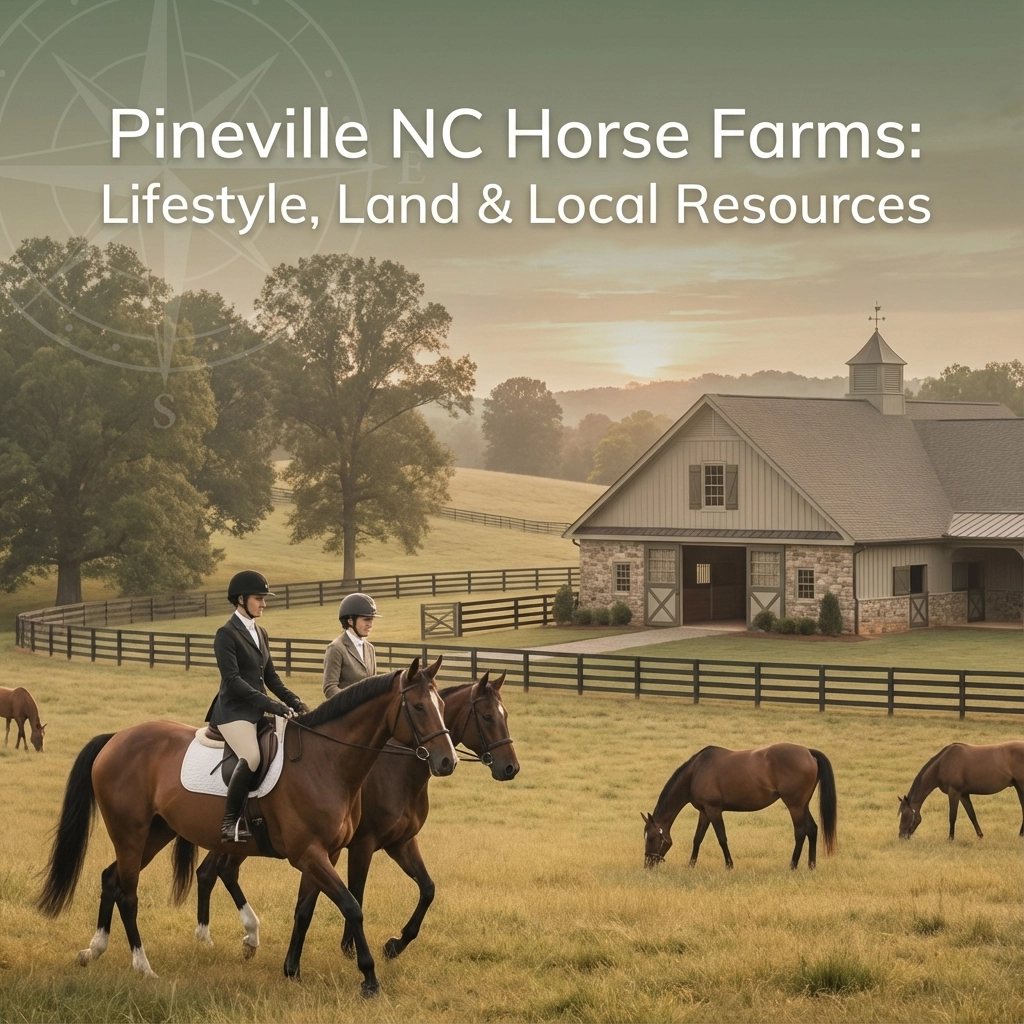
Pineville is a small town of about 10,600 people, and its zoning ordinance does not list keeping horses as a use, so a horse at home inside Pineville would need a zoning determination before anything else. For acreage, south Charlotte horse owners have three realistic directions: unincorporated Union County to the southeast, and York County and Lancaster County across the South Carolina line. Boarding fills the gap while you search, and North Carolina law shapes how that boarding relationship works.
Pineville by the numbers
The town's website lists a population of 10,602 and describes Pineville as 20 minutes from uptown Charlotte. Its history page says Pineville was once known as a mule trading center, with meadows where traders turned their animals out to pasture, and the area became known as Morrow's Turnout. The same page says suburbanization transformed the town in the 1990s, bringing a wave of retail development that included Carolina Place Mall.
Pineville's combined property tax rate with Mecklenburg County was 79.27 cents per $100 in the N.C. Department of Revenue's fiscal year 2025-26 table (30 cents for the town plus 49.27 cents for the county).
What Pineville's zoning says about horses
Pineville's 2026 zoning ordinance applies within the town's corporate limits, and Section 1.4.1 states that bona fide farms are exempt. Its largest-lot district, R-44, requires at least 44,000 square feet and 100 feet of width, and accessory buildings must sit in the rear yard.
The town's 2025 Table of Use Classifications lists animal grooming, animal hospitals, kennels and even a farm supply store, but it has no listing for keeping horses, stables or general agriculture. Section 6.4.2 explains what happens to a use that is not on the chart:
"If an applicable zoning use and associated regulation cannot be found in this Ordinance as determined by the Planning Director that zoning use shall be considered not permitted."
The same section lets the Planning Director decide whether an unlisted use fits an existing category, and it allows an applicant to seek a text amendment. If you own or are considering a larger Pineville parcel, ask the Planning Director for a written determination before you plan on a horse.
A Pineville ZIP code is not the same as Pineville
The town's planning FAQ makes a point worth knowing before you search by ZIP code:
"Zip code is independent from municipal limits."
The FAQ says neighborhoods west of Lancaster Highway with Pineville ZIP codes are in unincorporated Mecklenburg County, and it directs those residents to the county. It also notes that the town issues zoning letters for $150 per parcel, which verify a property's zoning district (not whether a particular use is allowed).
Where south Charlotte buyers find acreage
The table below uses Canopy Realtor Association's August 2026 figures. They cover all home sales, so read them as a sense of each area's price level, not the price of a horse farm.
| Area | County and state | Median sale, Aug. 2026 | What to check first |
|---|---|---|---|
| Union County (all) | Union, NC | $525,000 | Town limits vs. unincorporated land |
| Fort Mill | York, SC | $525,000 | Town vs. county zoning, SC tax rules |
| Town of Clover | York, SC | $350,000 | Town vs. county zoning |
| Lancaster County (all) | Lancaster, SC | $481,700 | Which version of the county's UDO applies |
| Mecklenburg County (for reference) | Mecklenburg, NC | $468,000 | Town or unincorporated, as in Pineville |
Union County
Outside its towns and their extraterritorial jurisdictions, Union County land is governed by county zoning, and North Carolina exempts bona fide farms from county zoning. Our Waxhaw buyer's guide explains how to tell a town parcel from an unincorporated one and what well and septic records to request. Our Union County page has the wider picture.
York County, SC
South Carolina taxes an owner-occupied legal residence and up to five contiguous acres at a 4 percent assessment ratio instead of 6 percent, and York County's Anne Springs Close Greenway in Fort Mill has public equestrian trails. Our York County guide covers both in detail.
Lancaster County, SC
Lancaster County is partway through a rewrite of its development rules. Its FAQ on the 2026 update says, "Lancaster County adopted its current UDO in 2016." The FAQ explains that the update carries out the Lancaster 2040 Comprehensive Plan, adopted in April 2024. If you are buying here, ask the county's zoning office which version of the ordinance will govern your parcel, and whether any change affecting horses or barns is pending.
Boarding: the practical bridge
For riders without land of their own, boarding is the step between owning a horse and owning a farm. One example close to the state line is the Anne Springs Close Greenway in Fort Mill, a 2,100-acre preserve whose stables offer pasture board:
"Horse boarding is offered at the barn in pastures around the property, which are soil tested annually, fertilized and seeded as required."
The Greenway lists pasture boarding at its Dairy Barn starting at $90 per week, effective Dec. 27, 2025, with winter hay, an annual Greenway membership with trail access, and use of the outdoor riding rings when available. At the starting rate, that is $4,680 a year per horse ($90 times 52 weeks). It is one data point, not a regional average, but it gives you a number to compare against what owning would cost.
North Carolina rules that shape a boarding agreement
If you board in North Carolina, two statutes are worth knowing before you sign.
The barn has a lien on your horse for unpaid board.
"Any person engaged in the business of boarding animals has a lien on the animals boarded for reasonable charges for such boarding which are contracted for with an owner or legal possessor of the animal."
The statute gives that lien priority over other security interests. Keep payment records, and make sure the contract spells out what the board rate includes so there is no dispute over extra charges.
Equine professionals must post a liability warning. G.S. 99E-3 requires equine professionals and activity sponsors to post signs, in letters at least three-quarters of an inch tall, warning that they are not liable for injuries resulting exclusively from the inherent risks of equine activities. Their written contracts for instruction or services must include the same notice. Under the statute, a barn that skips the sign and contract language cannot claim that protection, so look for the sign on your first visit.
What to settle in writing
- Exactly what the monthly or weekly rate covers: turnout, hay, grain, stall cleaning, blanketing.
- Who can authorize a vet or farrier, and your emergency contact plan.
- Notice period to leave, and what happens to unpaid charges.
- What insurance the barn carries and what it covers.
- Trailer parking, arena hours and trail access.
From boarding to buying in four steps
- Set a radius. Decide how far you will haul to your trainer, vet and trails.
- Choose a state. North Carolina and South Carolina differ on property tax and on horse paperwork at the state line.
- Check jurisdiction before touring. Town limits, ETJ and county rules decide whether horses fit.
- Price the land, not the house. Compare horse properties with horse property sales.
Our Charlotte-area horse farm listings and South Carolina horse farm listings are good starting points, and our Matthews guide covers Matthews, Mint Hill and nearby Union County towns.
If you are boarding in south Charlotte and want to map out a move to your own land, contact us.
Sources
- Town of Pineville, About
- Town of Pineville, Planning and Zoning
- Town of Pineville, Zoning Ordinance (2026)
- Town of Pineville, Table 6-1 Use Classifications (2025)
- N.C. Department of Revenue, Fiscal Year 2025-2026 County and Municipal Property Tax Rates
- Canopy Realtor Association, Housing Market Sortable Statistics, August 2026
- South Carolina Code of Laws, Title 12, Chapter 43 (Section 12-43-220)
- Lancaster County, SC, 2026 Unified Development Ordinance Frequently Asked Questions
- Anne Springs Close Greenway, About
- Anne Springs Close Greenway, Horseback Riding
- North Carolina General Statutes, G.S. 44A-2, Persons entitled to lien on personal property
- North Carolina General Statutes, G.S. 99E-3, Warning required
- North Carolina General Statutes, G.S. 160D-903, Agricultural uses