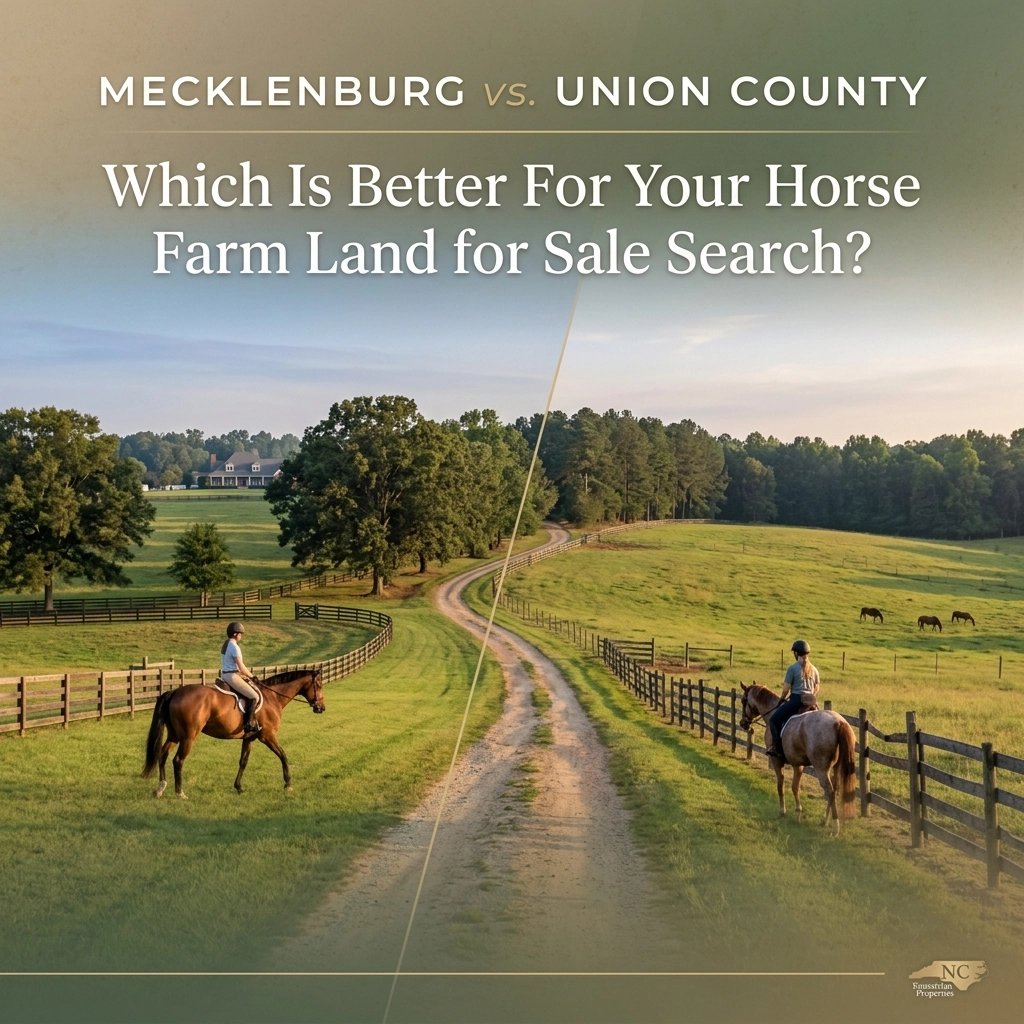
For most horse buyers, Union County is the more practical place to find acreage: more than half its land was in farms in 2022, its farmland averaged about $6,100 per acre, and several of its towns levy very low municipal tax rates. Mecklenburg County makes sense when you need to be close to Charlotte and can work with a smaller parcel, a higher price per acre, and town zoning rules. The details below show where each county comes out ahead.
The two counties side by side
| Measure | Mecklenburg | Union |
|---|---|---|
| Land in farms, 2022 | 7,704 acres | 212,066 acres |
| Land in farms, 2017 | 11,674 acres | 186,626 acres |
| Share of county land in farms, 2022 | 2.3% | 52.4% |
| Number of farms, 2022 | 165 | 882 |
| Average farm size, 2022 | 47 acres | 240 acres |
| Farmland value per acre (land and buildings), 2022 | $27,096 | $6,148 |
| Population, July 1, 2025 | 1,233,383 | 267,674 |
| Population change since April 2020 | +10.6% | +12.4% |
| County tax rate per $100, FY 2026-27 | 49.27 cents | 43.42 cents |
| Latest and next reappraisal | 2023 and 2027 | 2025 and 2029 |
| Median sales price, all homes, Sept. 2026 | $450,000 | $474,000 |
Farm figures come from the 2022 Census of Agriculture, population from the Census Bureau's county estimates, tax rates and reappraisal years from the NC Department of Revenue, and sales data from the Canopy Realtor Association. The median price covers every type of home sold, so it says little about horse property directly.
Land supply: the biggest difference
Mecklenburg lost about a third of its farmland in five years, from 11,674 acres in 2017 to 7,704 in 2022. Union went the other way, from 186,626 to 212,066 acres. Union's average farm is 240 acres; Mecklenburg's is 47.
With only 165 farms left in Mecklenburg, expect a short list of options at any one time, and mostly smaller parcels. Union's larger farm base gives you more room to compare tracts of 10 acres or more, bare land, and older farms with fencing and barns already in place.
The per-acre gap is large. At 2022 averages, 12 acres of farmland would come to about $325,152 in Mecklenburg (12 x $27,096) and about $73,776 in Union (12 x $6,148). Those are averages of land and buildings across all farms, not asking prices, but they show why horse buyers priced out of Mecklenburg tend to look south and east. Our guide to land for horses covers what to check on the parcel itself.
Zoning: who regulates the parcel
North Carolina splits zoning power by location. Under G.S. 160D-201, a city regulates inside its corporate limits and its extraterritorial jurisdiction (ETJ), and a county regulates everywhere else in the county.
That matters for horses because of the bona fide farm exemption:
"County zoning regulations may not affect property used for bona fide farm purposes; provided, however, that this section does not limit zoning regulation with respect to the use of farm property for nonfarm purposes."
The same statute extends the exemption to bona fide farms in a city's ETJ, but not to land inside city limits. State law (G.S. 106-581.1) counts the care, training, and boarding of horses as agriculture. Evidence of a bona fide farm can include a farm sales tax exemption certificate, present-use value eligibility, a Schedule F, or a forest management plan.
What this means for each county:
- Mecklenburg: If the parcel is inside Charlotte or a town such as Huntersville, Mint Hill, or Matthews, the town's own animal and zoning rules apply in full. If it is in a town's ETJ, the bona fide farm exemption can apply. Our Huntersville guide walks through one example.
- Union: Unincorporated land falls under the county's rules, where the bona fide farm exemption can apply. Towns such as Weddington, Waxhaw, and Marvin have their own ordinances. See our Weddington zoning guide for how one Union County town handles horses.
Either way, confirm the jurisdiction with the planning office before you make an offer, and ask what it would take to have your use treated as a bona fide farm.
Property taxes: rates and reappraisal timing
Mecklenburg kept its rate flat for the fiscal year that began July 1, 2026:
"The Mecklenburg County property tax rate remains at its current level of 49.27 cents per $100 of assessed valuation."
The NC Department of Revenue's 2026-27 county table lists Union at 43.42 cents per $100. A worked example with the county rate only, on a property assessed at $900,000:
- Mecklenburg: $900,000 / 100 x $0.4927 = $4,434.30
- Union: $900,000 / 100 x $0.4342 = $3,907.80
Those nominal rates overstate the difference. Counties reappraise in different years, so NCDOR also publishes effective rates that adjust each county's rate by its sales assessment ratio, a comparison of assessed values with recent sale prices. In NCDOR's 2025-26 table, Mecklenburg's ratio was 0.8878 and its effective county rate was 43.74 cents per $100, while Union's ratio was 0.9985 and its effective rate was 43.35 cents. Once Mecklenburg's older assessments are taken into account, the two county rates were nearly the same last year.
Town taxes can matter more than the county gap. NCDOR's 2025-26 table shows a Charlotte rate of 27.41 cents, Huntersville 22.75 cents, and Mint Hill 22.5 cents on the Mecklenburg side. In Union County, Waxhaw was 29 cents, while Marvin was 5.63 cents and Weddington 3.5 cents. Special district taxes, such as fire districts, are not included in NCDOR's table, so get the full tax bill history for the parcel.
Timing matters too. NCDOR shows Mecklenburg's latest reappraisal in 2023 and the next scheduled for 2027, while Union reappraised in 2025 and is next scheduled for 2029. NCDOR notes that reappraisals take effect January 1 of the year shown. If you buy in Mecklenburg now, your assessed value may change with the 2027 reappraisal. Separately, NCDOR reports that Mecklenburg added a 1% local sales and use tax effective July 1, 2026.
Present-use value: can horse land qualify?
North Carolina's present-use value (PUV) program taxes qualifying farmland at its use value instead of market value. The statute's definition of agricultural land covers horses:
"For purposes of this definition, the commercial production or growing of animals includes the rearing, feeding, training, caring, boarding, and managing of horses."
The income test is where horse farms often stumble. Under G.S. 105-277.3, agricultural land generally needs at least 10 acres in actual production and an average gross income of at least $1,000 over the three years before January 1 of the year claimed. N.C. Cooperative Extension in Polk County explains the catch:
"Typically, horse farms have been harder to enroll, because the qualifying criteria of $1,000 of gross income per year must come from something produced on the farm, which doesn't include boarding or training fees."
N.C. Cooperative Extension, Polk County Center, Present Use Value for Farm Property Tax Reduction
The same article notes that grazing fees have been counted, and it works an example of about $1,080 a year in grazing value for one horse on pasture for 250 days.
Two rules buyers should know:
- Transfer deadline. If you buy land already in PUV, G.S. 105-277.4 says the application required due to the transfer must be submitted within 60 days of the transfer date.
- Deferred taxes. The tax difference is carried as deferred taxes, and the deferred taxes for the preceding three fiscal years come due when the land loses eligibility.
Because Union has far more farmland and larger farms on average, PUV comes up more often there. Ask the seller for the PUV status and ask the county assessor what would trigger deferred taxes before you close. Your CPA or attorney should review the details.
Growth and development pressure
Both counties are growing. Union added about 29,500 people between April 2020 and July 2025, and Mecklenburg added about 117,800. In Canopy's September 2026 report, Union's year-to-date closed sales were up 10.1 percent from 2025 while Mecklenburg's were down 3.5 percent.
For a horse buyer, growth shows up next door. Before you buy, look at recent rezoning cases near the parcel, planned road projects, and the size of any vacant tracts around it. A quiet hayfield beside your pasture today could be a subdivision application next year.
Which county fits you
- Choose Mecklenburg if you need a short drive into Charlotte, can work with a few acres, and are comfortable with town rules on animals, setbacks, and accessory buildings.
- Choose Union if you want 10 acres or more, may qualify for PUV, and prefer county rules with room for a bona fide farm exemption.
- Look at both if your budget sits in between. At 2022 averages, one acre of Mecklenburg farmland was worth about as much as four acres in Union.
Our county pages for Mecklenburg and Union cover each area in more detail. If you want help comparing two specific parcels, contact us.
Sources
- USDA NASS, 2022 Census of Agriculture, North Carolina County Table 8
- U.S. Census Bureau, County Population Totals 2020 to 2025 (data file)
- NC Department of Revenue, County Property Tax Rates and Reappraisal Schedules, Fiscal Year 2026-2027
- NC Department of Revenue, 2026-2027 County Tax Rates (spreadsheet)
- NC Department of Revenue, 2025-2026 County and Municipal Tax Rates and Effective Tax Rates
- NC Department of Revenue, 2025-2026 Tax Rates and Effective Tax Rates (spreadsheet)
- Mecklenburg County, Board of County Commissioners Adopts $2.6 Billion Operating Budget for FY2027
- Canopy Realtor Association, Local Market Update September 2026: Mecklenburg County
- Canopy Realtor Association, Local Market Update September 2026: Union County
- North Carolina General Assembly, G.S. 160D-201
- North Carolina General Assembly, G.S. 160D-903
- North Carolina General Assembly, G.S. 106-581.1
- North Carolina General Assembly, G.S. 105-277.2
- North Carolina General Assembly, G.S. 105-277.3
- North Carolina General Assembly, G.S. 105-277.4
- N.C. Cooperative Extension, Polk County Center, Present Use Value for Farm Property Tax Reduction