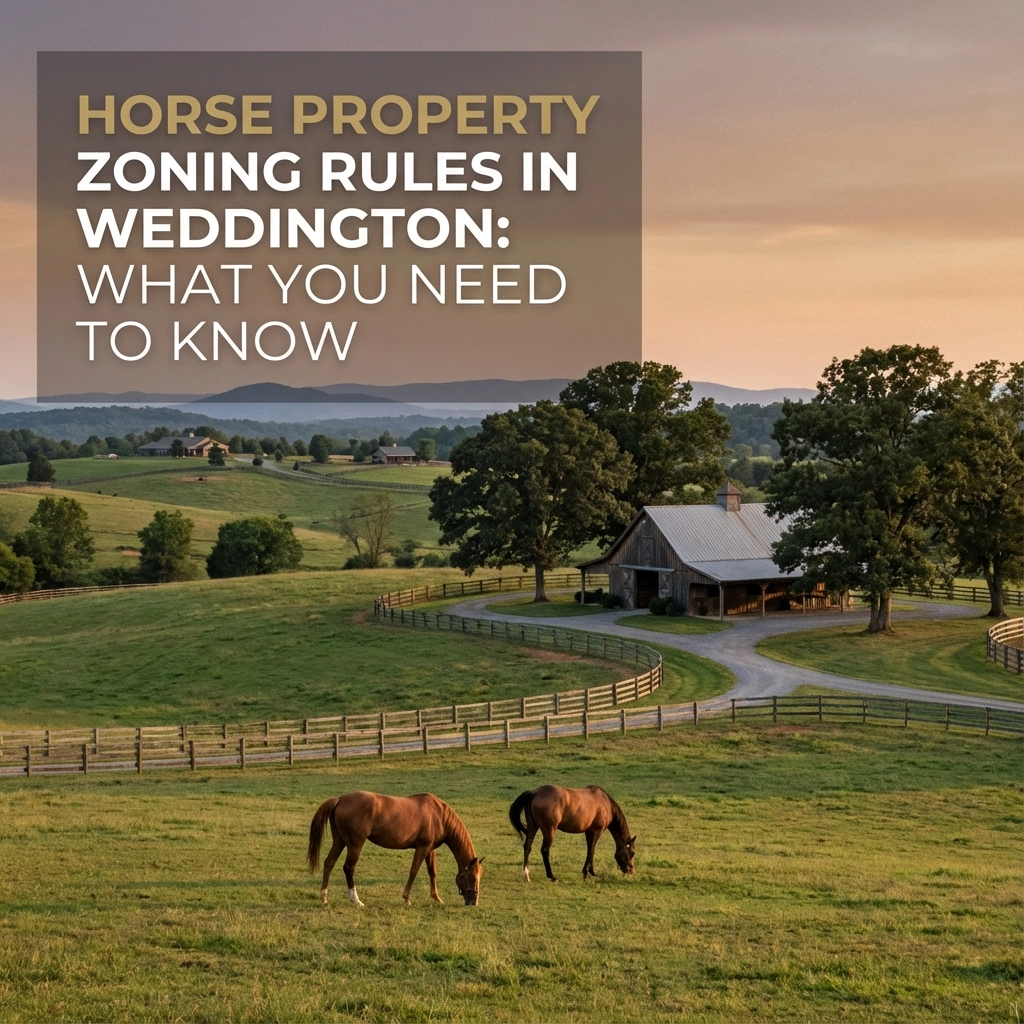
Weddington allows horses by right in four of its residential zoning districts (R-80, R-60, R-40 and R-CD), but a lot's size and shape decide whether horses actually fit. Under the town's Unified Development Ordinance, one horse needs at least 40,000 square feet of contiguous fenced land, two horses need 80,000 square feet, and any structure that houses horses must sit at least 60 feet from every property line. Before you buy, run those numbers against the survey, then read the subdivision covenants, which can be stricter than the town.
This guide summarizes the Weddington UDO as posted on the town's website (adopted April 12, 2021, with amendments through August 11, 2025). Ordinances change, so confirm the current text and your parcel's zoning with Weddington's planning staff before you rely on any of it.
Weddington's ordinance, not Union County's, controls inside town limits
Weddington is a town in Union County, and inside its limits the town's UDO sets the rules for horses, barns and fences. North Carolina's bona fide farm exemption in G.S. 160D-903(a) limits county zoning, not town zoning, so a Weddington parcel does not escape the town's horse rules just because it is used for farming. (Our Waxhaw buyer's guide walks through how to tell a town parcel from an unincorporated one.)
The town's tax page notes that Union County performs all property assessments. Weddington's own 2026 rate is 3.5 cents per $100 of value, billed separately from the county.
Which districts allow horses
Weddington's Table 1 lists "Agricultural Uses" and "Horse Farm or Academy" as by-right uses in four districts. The dimensional figures below come from the UDO's Table 2.
| District | Minimum lot size | Minimum lot width | Horses by right? |
|---|---|---|---|
| R-80 | 80,000 sq. ft. | 150 ft. | Yes |
| R-60 | 60,000 sq. ft. | 125 ft. | Yes |
| R-40 | 40,000 sq. ft. | 120 ft. | Yes |
| R-CD (conventional) | 40,000 sq. ft. | 120 ft. | Yes |
| R-CD (conservation) | 18,000 sq. ft. (20,000 average) | 100 ft. | District yes, but see below |
| R-40(D) | 40,000 sq. ft. | 100 ft. | No |
| RE | 20,000 sq. ft. | 100 ft. | No |
R-40(D) is a two-family district created for one area of town, and RE is meant for subdivisions with 20,000-square-foot lots that were annexed by the town and do not fit its other districts. Neither lists agricultural uses or horse farms.
How many horses: the fenced-area rule
Section D-917D(A) sets a minimum lot size for agricultural uses (80,000, 60,000 or 40,000 square feet depending on district) and requires at least five acres for any agricultural use with livestock that weigh 250 pounds or more at maturity. Horses get a specific carve-out:
"Notwithstanding this requirement, lots whose agricultural use consists exclusively of one horse shall be required to have a minimum of 40,000 square feet of contiguous fenced land area designed to accommodate the horse."
Town of Weddington, Unified Development Ordinance, Section D-917D(A)
The same section requires 80,000 square feet of contiguous fenced land for two horses. Two details matter here. First, the carve-out is written for lots whose agricultural use is "exclusively" horses, so ask the town before adding a cow or other large livestock, which the five-acre rule covers. Second, the area must be contiguous and fenced, so scattered patches of yard do not count.
Once you reach three horses, the UDO treats the property as a different use:
"Horse farm or academy means a site where three or more horses are housed, bred, boarded, trained or sold."
Town of Weddington, Unified Development Ordinance, Appendix 1 definitions
A horse farm or academy is also allowed by right in R-80, R-60, R-40 and R-CD. Its supplemental rule in Section D-917D(B) sets setbacks (covered below) but does not list a separate acreage figure. If you plan three or more horses, ask the zoning administrator in writing how acreage applies to your parcel.
The legal minimum is not a grazing plan
Forty thousand square feet is about 0.92 acre. That is the town's floor for one horse, not a pasture recommendation. NC State Extension's guidance points much higher:
"In general, research shows that around two acres of pasture per mature 1,100-pound horse."
N.C. Cooperative Extension, Martin County Center, Developing Pasture for Horse Nutrition
A Weddington lot that just meets the fenced-area minimum will usually need purchased hay and a sacrifice area much of the year. See our pasture management guide for how to plan around that.
Worked examples: does the lot actually fit?
These examples use only the UDO's numbers. They show why the survey matters more than the listing's acreage.
A 2-acre lot zoned R-40 (87,120 square feet). One horse needs 40,000 square feet fenced, which leaves 47,120 square feet for the house, driveway, septic field and repair area, and yard. Two horses would need 80,000 square feet fenced and leave only 7,120 square feet for everything else. On paper two horses are possible; in practice there is almost no room left for the house and septic system.
A 3-acre lot zoned R-60 (130,680 square feet). Two horses on 80,000 square feet of fenced pasture leaves 50,680 square feet, a bit over 1.1 acres, for the home site. This is closer to the size where two horses can work, provided the barn and manure setbacks below also fit.
The width test for a barn. Section D-917D(A) says structures housing horses must be at least 60 feet from any property line. On a lot with the R-40 minimum width of 120 feet, 60 feet from each side line consumes the entire width, leaving no legal spot for a stall barn near the minimum-width part of the lot. At the R-60 minimum of 125 feet, the strip is 5 feet wide. At the R-80 minimum of 150 feet, it is 30 feet. Corrals for horses are exempt from these setbacks, so a fenced paddock can run closer to the line than the barn can.
The manure test. Waste removed from a horse structure must be kept at least 150 feet from any property line. That requires a spot at least 300 feet from side to side and front to back. A rectangular 2-acre lot that is 150 feet wide has no such spot. If your lot cannot meet this, plan on hauling manure off the property and confirm with the town that this satisfies the rule.
Barns and other accessory structures
Section D-917D(M), on accessory uses and structures, adds rules that affect when and where you can build:
- House first. The UDO states: "Accessory structures may not be built prior to the construction of the principal structure." Buying raw land and putting up the barn before the house is not an option under this rule.
- Side and rear setbacks. General accessory structures must be at least 15 feet from side and rear lines and no closer to the street than the house. For horse barns, the 60-foot use-specific setback controls, because the UDO's lot standards section says the use-specific requirement wins when the two conflict.
- Height and size. Barns and other bona fide farm-related structures are not held to the accessory height limits, only to the district's 35-foot maximum. They are also excluded from the cap that keeps other accessory structures to 50 percent of the house's floor area.
- Permits. The UDO's submittal list for a zoning permit for an agricultural building requires an application, the fee from the town's adopted schedule, a plot plan sketch showing the lot boundary, existing structures and distances to each lot line, and building elevations or a manufacturer's spec sheet.
Conservation subdivisions and HOA common land
Weddington's R-CD district includes a conservation subdivision option. Those lots can be as small as 18,000 square feet (averaging 20,000 per subdivision), with land set aside as conservation area. The UDO lists pastureland and horse farms among the allowed uses on that conservation land.
That creates an unusual situation. A conservation lot is too small to meet the 40,000-square-foot fenced-area rule on its own, but the neighborhood's conservation land might host horses if the owners' association and its documents allow it. If you see a listing in a conservation subdivision that mentions horses, ask whether the horses are on the lot or on association land, and who controls that arrangement.
Covenants can be stricter than zoning
If the parcel is in a subdivision, look for recorded covenants. Zoning tells you what the town allows. Covenants tell you what your neighbors agreed to, and they can ban horses outright, cap animal numbers, or require board approval for barns and fences. North Carolina requires sellers to put the existence of these rules in writing:
"With regard to transfers described in G.S. 47E-1, the owner of the real property shall furnish to a purchaser an owners' association and mandatory covenants disclosure statement."
The disclosure tells you that covenants exist. It does not tell you what they say. Get the recorded declaration, any amendments and the architectural guidelines, and read the animal and outbuilding sections before your due diligence period ends. Our comparison of private farms and equestrian communities covers how to weigh HOA rules against shared amenities.
A road project to check if you are near N.C. 84
NCDOT project U-3467 proposes extending Rea Road 1.7 miles east from N.C. 16 (Providence Road) to N.C. 84 (Weddington Road) near Twelve Mile Creek Road, and widening 2.7 miles of N.C. 84 from two to four lanes between Twelve Mile Creek Road and Waxhaw-Indian Trail Road. NCDOT lists the project as funded for $179 million. It scheduled a drop-in public meeting for Thursday, Oct. 22, 2026, from 5 to 7 p.m. at Weddington United Methodist Church-Helms Hall, 13901 Providence Road, and is taking comments through Nov. 23, 2026. If a property fronts either road, review the project maps for right-of-way needs before you design fencing or a barn near the road.
Questions to ask before you make an offer
- What is the parcel's zoning district, confirmed by the town in writing?
- Is the parcel inside Weddington's limits, and does the tax bill show the town levy?
- Can the survey show the required contiguous fenced area for the number of horses you plan, with room left for the house, septic and repair area?
- Is there a spot for a barn at least 60 feet from every line, and for manure storage at least 150 feet from every line?
- If you plan three or more horses, how does the town apply acreage to a horse farm?
- Do the recorded covenants allow horses, barns and the fence style you want?
- Did the existing barn and fencing receive zoning permits? Ask the town for the permit history.
For the broader search, see our land for horses guide and the Union County page. If you are weighing Weddington against nearby areas, our Waxhaw, Weddington and Mooresville comparison lays out taxes and rules side by side.
If you want help checking a specific Weddington parcel against these rules, contact us.
Sources
- Town of Weddington, Unified Development Ordinance (amended through Aug. 11, 2025)
- Town of Weddington, Tax Collection
- North Carolina General Statutes, G.S. 160D-903, Agricultural uses
- North Carolina General Statutes, G.S. 47E-4, Required disclosures
- N.C. Cooperative Extension, Martin County Center, Developing Pasture for Horse Nutrition
- NCDOT, Rea Road Extension project page
- NCDOT, Public Meeting Scheduled for Union County Road Improvements (Oct. 19, 2026)