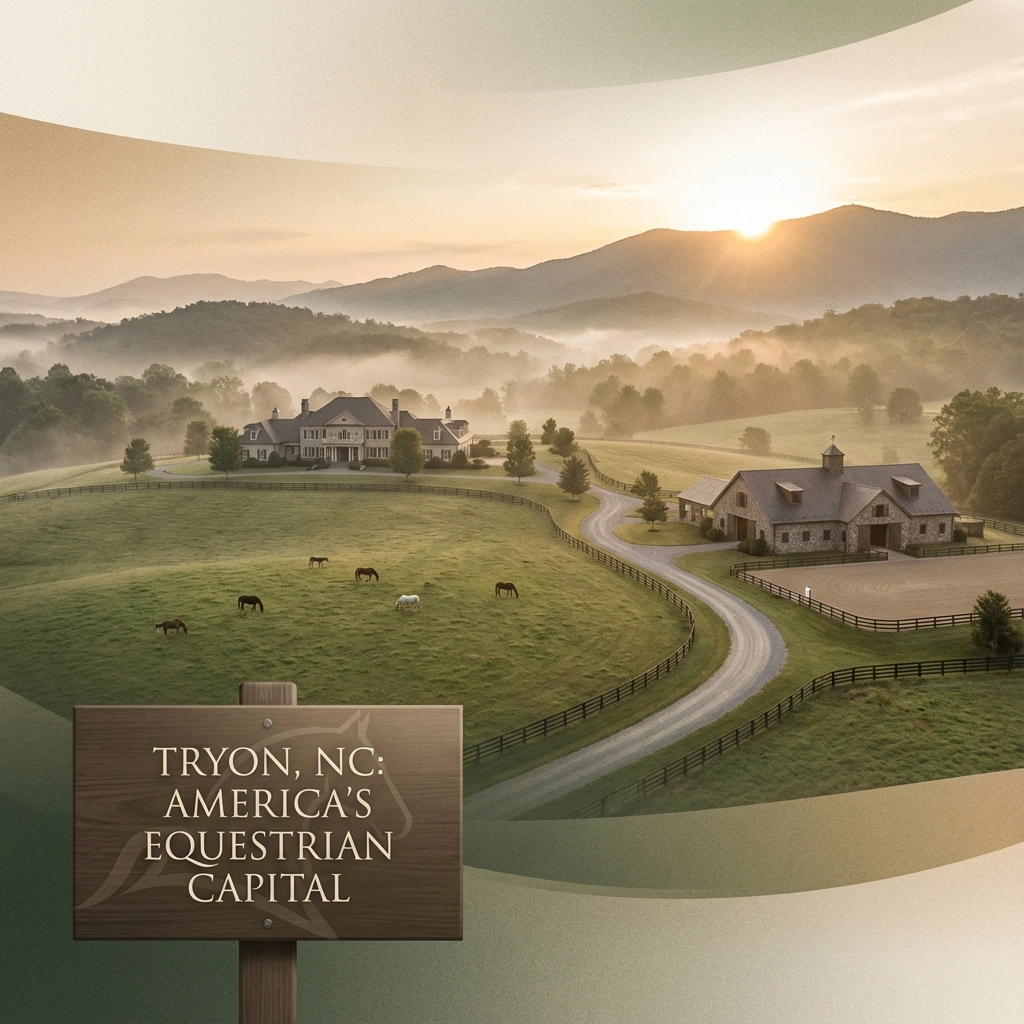
Much of what a Tryon-area horse property is worth comes down to two things you can't see from the driveway: your legal right to ride onto the Foothills Equestrian Trails Association (FETA) trail system, and which zoning rules govern the parcel. Before you make an offer, get trail access confirmed in writing, find out whether Polk County or the Town of Tryon zones the land, and walk the slopes where the barn and arena would go. Tryon International Equestrian Center (TIEC) adds a busy competition calendar nearby, along with event traffic you should test for yourself.
What TIEC means for nearby property
TIEC sits off Exit 170 on US 74 in Mill Spring. According to the venue, its first horse shows ran in July 2014, its grand opening was in June 2015, and it now hosts more than 40 horse shows a year on a 1,600-acre property. It hosted the FEI World Equestrian Games in 2018. The venue's own directions put Charlotte Douglas International Airport about 1 hour 10 minutes away, Greenville-Spartanburg about 45 minutes, and Asheville Regional about 30 minutes.
For a buyer, that raises three practical questions.
How close do you want to be? Living near the show grounds helps if you compete, coach, or haul in for lessons. It also means more trailers, visitors, and evening events on the roads around the venue. Drive the route from the property to US 74 on a Saturday during a show, then again on a weekday, before you decide.
What could be built near you? Polk County's zoning ordinance includes an Equestrian (E) district and an Equestrian Village (EV) district. The county describes the E district this way:
"The Equestrian district is intended to provide locations for most types of land uses allowed in the other zoning districts, including, without limitation, residential uses (including but not limited to clustered developments and group developments), show and event uses, commercial uses, and other uses consistent with and beneficial to the orderly development of mixed-use equestrian communities and/or resorts."
If a parcel borders E or EV land, ask the Polk County Planning Department what has been approved or proposed next door. Show, event, and commercial uses can change how a quiet farm feels.
Will you rent anything out? That has its own rules, covered below. For the venue itself, see our TIEC guide.
FETA trails: how access actually works
FETA describes itself as an alliance of rural landowners and riders preserving historic horse trails in Polk County. The association says it was formed in 1993 and that its system covers an estimated 125 to 150 miles across roughly 15 square miles of Hunting Country, bounded approximately by Highway 108 on the north, Highway 14 on the south, Highway 176 on the west, and Highway 9 on the east. FETA owns none of the trails.
FETA publishes a Buyer Beware page written for people in your position. Its first point:
"FETA trails are entirely on PRIVATE PROPERTY. Riding these trails is a privilege not a right."
Other points from FETA's own pages that affect a purchase:
- Easements vary. Some trails are secured by deeded, recorded riding easements. Others run under permitted-use agreements, which FETA says are more susceptible to closure by landowners, although closures are uncommon.
- Membership is local. Since 2001, riding membership has been limited to people who live in, own land in, or board a horse in Polk County, NC, or Landrum or Campobello, SC. FETA notes that some restrictions apply to commercial and private boarding facilities.
- Reciprocity is expected. FETA landowners have a long-standing rule that if your land adjoins FETA trails, present or future, you open your trails in return.
- Covenants matter. If you buy in an equestrian development, FETA says its covenants must let FETA members ride the development's trails where they connect, or landowners there can lose the ability to join.
- Trail maps stay private. Members may use tracking apps but may not post or share their recorded tracks publicly.
- Wet weather closes trails. FETA runs a trail status line and notes that sometimes only part of the system is open after rain.
FETA also warns about marketing:
"Many real estate ads use the FETA name as a marketing tool for property nowhere near the trails or with dangerous hacks on busy roads."
FETA recommends asking the seller and agent for a written statement that you would be eligible to join and where the nearest trail access is. We agree, and we would add a few questions.
Trail questions to settle before your offer
- Is there a recorded FETA easement on this parcel? FETA suggests checking with FETA, a real estate attorney, or public records.
- Where is the nearest trail access, and can you reach it without riding on pavement or a busy road?
- Is the connecting trail under a deeded easement or a permitted-use agreement?
- If the property is in a subdivision, do the recorded covenants allow FETA access to its trails?
- Do you plan to board other people's horses? Ask FETA how its boarding restrictions would apply to you.
- Are you prepared to share your own trails if your land adjoins the system?
A trail easement is not the same thing as a conservation easement. If you are weighing both, our post on conservation easements and NC horse farms covers that separate decision.
Which zoning rules apply: Polk County or the Town of Tryon
Confirm the jurisdiction on the official zoning map, not just the mailing address. Polk County's ordinance applies to unincorporated areas outside any town's extraterritorial zoning area. Tryon's ordinance applies inside the town limits and in Tryon's extraterritorial jurisdiction (ETJ). Columbus and Saluda are separate municipalities, so check with each town for parcels inside their limits.
Polk County
The county ordinance starts with an exemption for bona fide farms:
"This ordinance shall in no way regulate, restrict, prohibit, or otherwise affect bona fide farms within the jurisdiction of this ordinance, now enacted, or hereafter amended or revised. Any use of such property for nonfarm purposes, however, shall be subject to this ordinance."
State law (G.S. 106-581.1) counts the raising, care, and training of horses, including boarding, as agriculture. Ask the planning office, and your attorney if needed, if your own operation qualifies as a bona fide farm under G.S. 160D-903. G.S. 160D-903 lists a farm sales tax exemption certificate, present-use value eligibility, a Schedule F, or a forest management plan as sufficient evidence, though other evidence may also be considered.
If the exemption does not apply, these details from the county ordinance matter:
- Minimum lot sizes: 1 acre in RE-1, 2 acres in RE-2, and 5 acres in RE-5.
- District intent: RE-5 lists private stables and nonprofit private equestrian courses among its intended principal uses. The AR-5 description names horse farms and stables among typical uses.
- Barns on smaller tracts: The permitted-use table allows an agricultural building on 10 acres or more by right in every district. On less than 10 acres, it is a special use in every district. Ask the planning office if your barn falls in that category.
- Stables and rentals: Both are listed as permitted in some districts and not others, so check the district before you plan.
Town of Tryon
Tryon's zoning ordinance (Chapter 154, as amended March 21, 2023) handles animals in two places. Its agricultural-use standards say no livestock may be kept on a lot of less than 2 acres, allow no more than one animal unit per 5,445 square feet (1/8 acre), and require livestock to be fenced at least 150 feet from an adjacent dwelling, with an exception for houses built after the containment area. Separately, the town regulates equestrian uses, defined as uses that include boarding horses or horseback riding. For those, stables, barns, and related structures must sit at least 300 feet from abutting residentially zoned property.
A 300-foot setback can rule out a barn site on a narrow parcel, so ask the town which standard applies to the horses you plan to keep. Our Polk County page and Tryon area page cover the wider area.
Slopes, soils, and where the barn goes
Polk County is foothills country, and many parcels have more slope than a typical Piedmont farm. You need flat, well-drained ground for a barn pad, an arena, and turnout. Penn State Extension puts it plainly:
"Some sections of the site may be too steep or rocky for pasture use, or the soil may be unsuitable for adequate grass growth."
Ways to check before you commit:
- Look up the soils. The USDA NRCS Web Soil Survey maps soils for the parcel. NRCS describes soil surveys as useful for general farm and local planning, and notes that some uses still need an onsite investigation.
- Walk it after a hard rain. Note where water runs, where it pools, and whether the drive washes out.
- Measure the flat ground. A 100 by 200 foot arena covers 20,000 square feet, about 0.46 acre, before you add the cut and fill slopes around it.
- Ask about grading rules. NC DEQ says an erosion and sedimentation control plan must be filed for any land-disturbing activity of more than one acre, at least 30 days before work starts. DEQ also says agricultural land used to produce plants and animals is generally exempt, with agricultural questions handled by the NCDA&CS Division of Soil and Water Conservation and local soil and water districts. A house site, driveway, and arena built together can cross the one-acre line, so ask early if your project is covered.
Renting near TIEC: rules to check first
Some buyers plan to rent a guest house or the main house to competitors during the show season. Polk County's ordinance defines a residential vacation rental as renting a dwelling for less than 90 days, and the permitted-use table allows that use only in certain districts. The ordinance exempts incidental rentals: no more than two rentals in a calendar year, totaling no more than two weeks, with no advertising.
State sales tax also applies. G.S. 105-164.4F taxes accommodation rentals at the general state rate, which G.S. 105-164.4 sets at 4.75 percent. A private residence rented for fewer than 15 days in a calendar year is exempt unless the rental is made through an accommodation facilitator. Ask your CPA about state and local taxes before you count on rental income, and read any subdivision covenants for rental limits.
Renting stalls to visiting competitors is a different question. That is boarding, which can bring FETA's boarding restrictions and the county's zoning rules into play. Our post on horse farm income in North Carolina covers what to check first.
A short pre-offer list for Tryon-area property
- Zoning jurisdiction and district confirmed on the official map.
- FETA eligibility and nearest trail access stated in writing, and easement status checked in public records.
- Subdivision covenants read for trail access, rentals, and livestock limits.
- Barn and arena sites walked, measured, and checked against setbacks.
- A show-weekend drive from the property to US 74.
If you want help researching a specific Tryon, Columbus, or Mill Spring parcel, contact us.
Sources
- Foothills Equestrian Trails Association, Buyer Beware
- Foothills Equestrian Trails Association, History and Mission
- Foothills Equestrian Trails Association, FAQ
- Foothills Equestrian Trails Association, Trail Info
- Tryon International, Ten Years of Tryon International
- Tryon International, Venue Information
- Tryon International, Trail Rides
- Polk County, Zoning Ordinance (amended Feb. 17, 2025)
- Polk County, NC, County Government Home
- Town of Tryon, Chapter 154 Zoning Ordinance (amended March 21, 2023)
- North Carolina General Assembly, G.S. 160D-903 Agricultural uses
- North Carolina General Assembly, G.S. 106-581.1 Agriculture defined
- North Carolina General Assembly, G.S. 105-164.4F Accommodation rentals
- North Carolina General Assembly, G.S. 105-164.4 Tax imposed on retailers
- Penn State Extension, Fence Planning for Horses
- USDA NRCS, Web Soil Survey
- NC DEQ, Erosion and Sediment FAQs