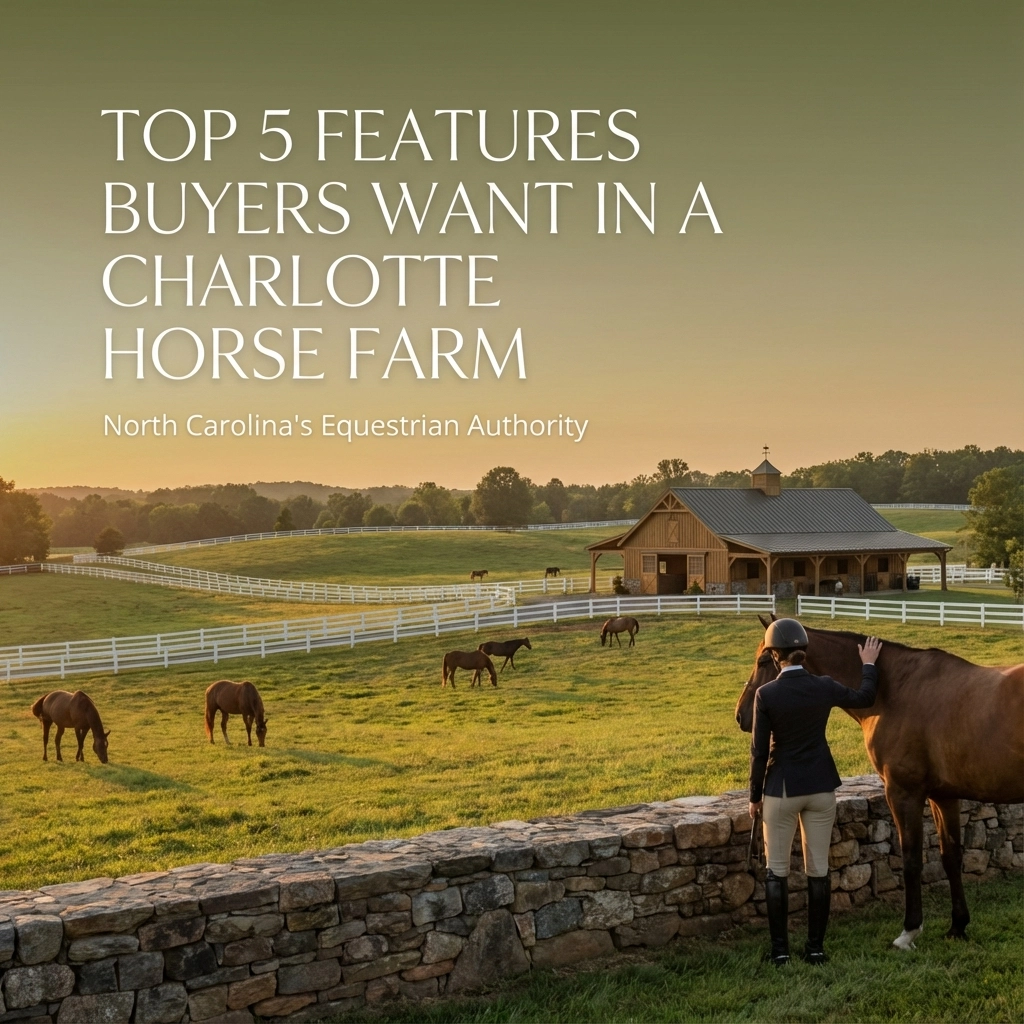
Horse farm buyers near Charlotte tend to weigh the same five features: usable pasture, safe fencing, a barn that works, a riding arena, and room to get a truck and trailer in and out. You can judge each one on a showing with a tape measure and a few questions. Each adds value only to the extent that comparable sales show buyers in that area pay for it.
Below is what to measure, what good looks like, and what should make you slow down.
1. Usable pasture
Buyers pay for grass, not acreage. N.C. Cooperative Extension in Martin County puts the guideline at around two acres of pasture per mature horse, so start by estimating how much open, grazeable ground the farm really has.
What to look for:
- Several separate fields, so horses can rotate while grass recovers
- Water in every field, or a short, practical route to it
- Shade or a run-in shed in fields where horses live out
- A dry lot or sacrifice paddock, so pastures aren't destroyed in wet weather
- All-weather lanes between the fields and the barn. Penn State Extension recommends lanes like these to connect turnout areas to the stable.
Bare dirt, heavy weeds, and fields with no water are fixable, but they cost time and money. Our guide to judging pasture before you buy shows how to read ground cover and weeds on a walk.
2. Safe fencing
Fence is one of the most expensive features to replace, and buyers notice it first. Penn State Extension sets the baseline:
"Horse fences should be 54 to 60 inches above ground level."
The same publication gives the details that separate horse fence from livestock fence:
- Top at wither height in paddocks and pastures, so a horse can't flip over it
- About 8 inches of clearance at the bottom, with a bottom rail no higher than 12 inches where foals are kept
- Openings either large or very small. Small, safe openings are less than 3 inches square, so a hoof can't get through.
- Rounded corners in shared pastures, so a dominant horse can't trap another
- Gates as tall as the fence, without diagonal cross bracing that can trap legs
- No cattle guards in place of gates. Penn State says horses don't consistently respect them.
On a showing, walk the whole perimeter, push on posts, and look for broken boards, sagging wire, and missing insulators on electric lines. Note which sections are newer. A farm with mixed fence types often means repairs happened piece by piece.
3. A barn that works
A pretty barn and a functional barn are not always the same building. Start with the stalls:
"A 12-foot x 12-foot stall is the standard recommendation for a 1,000-pound horse."
Penn State adds that stall walls shorter than 10 feet aren't recommended, that partitions should be at least 7 1/2 feet high (8 feet is standard), and that barn ceilings commonly run 10 to 12 feet, with 8 feet the minimum. For aisles, University of Kentucky Extension recommends at least 12 feet, depending on how the barn is used.
Then check how the barn runs day to day:
- Air. Windows that open, eave and ridge vents, and a high or open ceiling
- Hay storage. Penn State advises against storing hay and bedding over the stalls. A separate hay shed is a plus.
- Work rooms. A feed room horses can't reach, a tack room that stays dry, and a wash stall with drainage
- Water and power. Frost-free hydrants, safe lighting, and wiring in conduit
- Count working stalls. A listing may count stalls that now hold equipment or have damaged walls.
If you are open to a barn with living space or a barn-first property, browse our horse barns and barn homes.
4. A riding arena
An arena is only as good as what's under it:
"a successful arena surface is no better than the underlying foundation of base and sub-base it rests upon"
Penn State Extension, Riding Arena Footing Material Selection and Management
You can't see the base on a showing, but you can see its effects. Look for:
- Even depth. Walk the track and the center. Deep spots and hard spots suggest base or drainage problems.
- Drainage after rain. Puddles that linger, or footing washed into one corner, mean water isn't leaving.
- Size for your discipline. A small backyard ring may suit flatwork but not a full jump course or a standard dressage test.
- Rails, lights, and a water source for dust control, if you ride in summer heat or after work
Ask when the footing was last added or replaced and what it is. Our guide to evaluating arena footing explains how to test it on a visit.
5. Trailer access and parking
This is the feature buyers forget until moving day. University of Kentucky Extension frames farm layout around flow:
"Horse owners need to consider how horses, humans, vehicles, equipment, and water will flow through the operation."
University of Kentucky Cooperative Extension, Equine Layout and Facility Planning Checklist
Its checklist asks whether the entrance allows larger trailers and semi-trucks delivering hay, and whether parking is adequate for trailers. Penn State Extension adds that farm equipment needs 12- to 16-foot-wide lanes and that gates for vehicles and tractors should be at least 12 feet wide.
On the property, check:
- The turn in from the road. Can a truck and gooseneck swing in without dropping a wheel into the ditch?
- A loop or turnaround near the barn, so you never have to back a loaded trailer down the driveway
- Surface. Gravel that holds up in a wet February, not clay that ruts
- A level parking pad for the trailer, out of the way of daily traffic
- Overhead clearance under trees and wires along the route
How these features affect value
A feature adds value when buyers in that market pay for it. Fannie Mae's appraisal rules make the same point for small barns and stables on residential loans:
"The appraiser must demonstrate through the use of comparable sales with similar amenities that the improvements are typical of other residential properties in the subject area for which an active, viable residential market exists."
Fannie Mae Selling Guide, B4-1.3-05 Improvements Section of the Appraisal Report
In practice, a well-kept barn, sound fence, and good pasture help a property compete in an area where other horse farms sell. A lavish barn or indoor arena in an area with few similar sales may add less on appraisal than it cost to build. Features in poor condition become repair credits in negotiation.
If you are comparing listings, our horse property listings show what's available now. If you own a farm and wonder how these features affect its price, our free valuation is a starting point.
Quick scoring sheet
| Feature | Good sign | Red flag |
|---|---|---|
| Pasture | Several fields, water in each, a dry lot | One bare field, no water, standing mud |
| Fencing | 54 to 60 inches, tight posts, safe gates | Rot at posts, sagging wire, cattle guard |
| Barn | 12 x 12 stalls, air movement, separate hay storage | Hay over stalls, exposed wiring, low ceiling |
| Arena | Even footing, drains after rain | Puddles, washed corners, hard spots |
| Trailer access | Wide gates, turnaround, gravel parking | Tight turn-in, backing required, clay drive |
If you'd like help scoring a farm you're considering, contact us.
Sources
- N.C. Cooperative Extension, Martin County Center: Developing Pasture for Horse Nutrition
- Penn State Extension, Fence Planning for Horses
- Penn State Extension, Horse Stall Design
- University of Kentucky Cooperative Extension, Equine Layout and Facility Planning Checklist (ID-271)
- Penn State Extension, Riding Arena Footing Material Selection and Management
- Fannie Mae, Selling Guide B4-1.3-05: Improvements Section of the Appraisal Report